
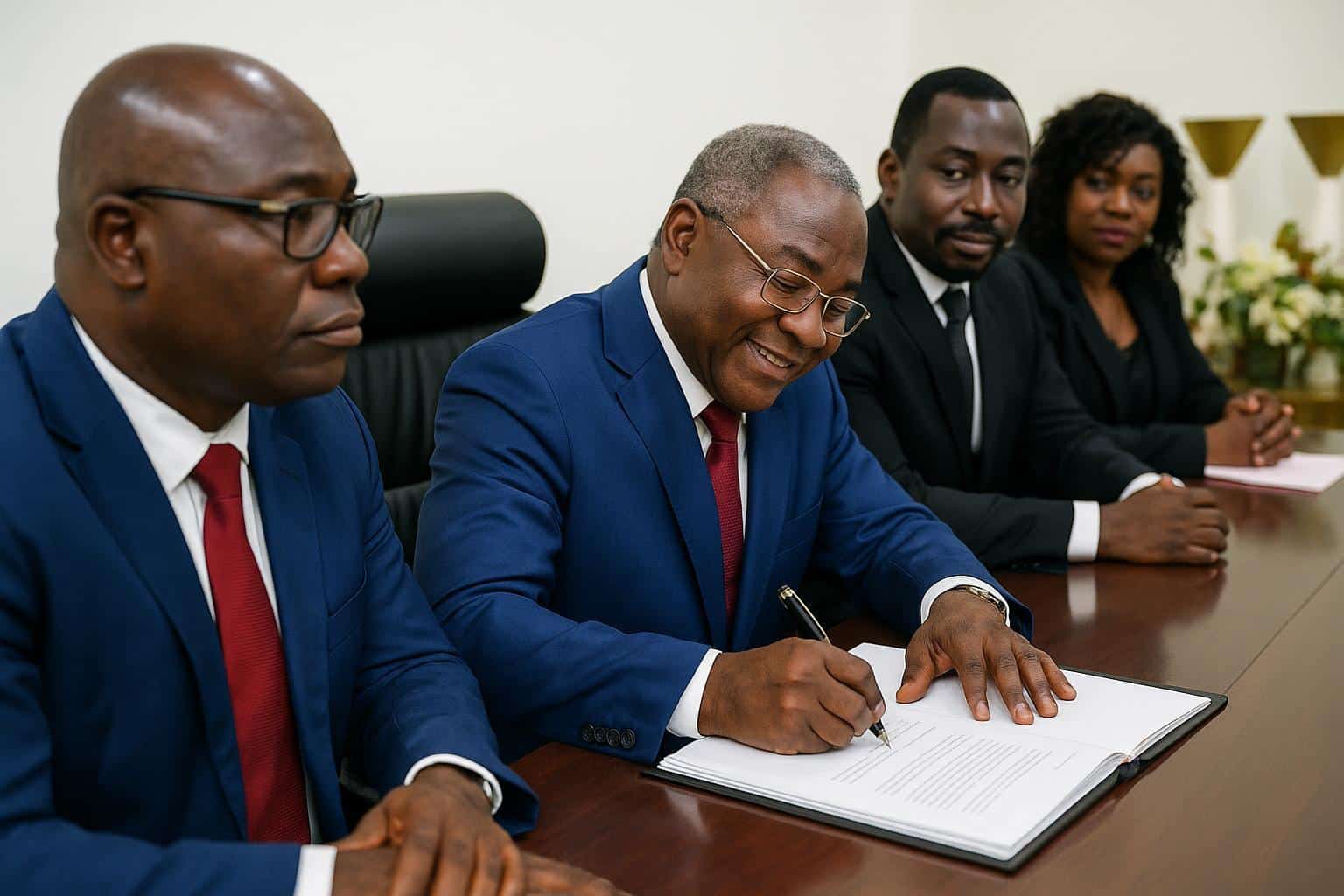
Ceremonial Handover Signals Fresh Start
Saturday’s carefully choreographed ceremonies in Pointe-Noire transferred the helm of three major public hospitals to new directors, signalling a fresh chapter for frontline care in the economic capital of Congo-Brazzaville.
Presiding over the successive handovers, Health and Population Minister Prof Jean Rosaire Ibara invoked continuity of state authority while urging managers to translate policy into measurable improvements for patients.
New Directors Take Office in Three Key Facilities
At Adolphe Sicé General Hospital, surgeon Lézin Cyriaque Goubakouly replaced Lambert Chakirou, who has been reassigned to other duties following eight years at the post.
Casimir Ondonda, formerly director of the Tié-Tié district hospital, stepped up to run the General Hospital of Loandjili in the fourth arrondissement, succeeding public-health specialist Sidonie Plaza.
In turn, Jean Victor Mambou took charge of Tié-Tié’s referral facility, promising to turn it into a benchmark for clinical excellence aligned with the Head of State’s national health agenda.
Presidential Decrees Underpin Smooth Transition
All three appointments were formalised by presidential decree on 3 November, a month before the formal handover, giving each incoming leader time to review files and consult staff.
Such lead-time, officials noted, reflects government efforts to avoid the administrative vacuum that previously slowed procurement and payroll decisions in provincial hospitals.
Governance Message: Accountability First
Addressing managers and union delegates gathered in Loandjili’s auditorium, Prof Ibara said public facilities must finance minor upgrades from their own revenues, reserving state subsidies for large-scale works such as new wards or imaging suites.
He urged directors to publish quarterly accounts, cultivate dialogue with staff and embed a culture of results, warning that lax bookkeeping would trigger audits and possible sanctions.
‘Respect for public property and for your teams is non-negotiable,’ the minister declared, drawing applause from local councillors and representatives of the Chamber of Commerce present.
Directors Outline Early Action Plans
Minutes after receiving his epaulettes, Ondonda pledged to run a swift diagnostic audit of Loandjili, from pharmacy stocks to biomedical engineering, before crafting a remediation calendar.
He told reporters the immediate objective is to rebuild trust between neighbourhood residents and hospital staff by reducing wait times and improving triage.
At Tié-Tié, Mambou set a 100-day target for revamping emergency protocols, installing solar back-up for cold-chain equipment and formalising partnerships with community pharmacies to curb stock-outs.
Goubakouly, the new steward of Adolphe Sicé, stressed workforce motivation, stating that ‘the staff room is not a pilgrimage site; only concrete action counts’.
Local Stakeholders React with Cautious Optimism
Outside the hospital gates, Pointe-Noire residents welcomed the leadership overhaul, though several expressed hopes that fee schedules would remain affordable amid the promised upgrades.
Union representative Justine Mabiala said workers were ready to collaborate, provided that outstanding allowances are processed promptly and training plans materialise.
Health economist Arnaud Nzassi, interviewed by phone, argued that strong managerial rotation can catalyse service quality if paired with decentralised purchasing powers and transparent billing.
Broader Context of Health System Modernisation
The Pointe-Noire reshuffle forms part of the National Health Development Plan, which seeks to raise hospital accreditation rates and expand universal coverage corridors by 2030.
Earlier this year, the Ministry piloted an electronic patient registry in Brazzaville; officials say lessons learned there will inform the new directors’ digitalisation drives.
Donor agencies, including the World Bank and the Development Bank, have earmarked concessional lines for equipment renewal, subject to hospital compliance with governance benchmarks.
For now, residents will judge the incoming teams on tangible changes: shorter queues, cleaner wards and medicines in stock.
Whether these expectations are met will depend on how deftly the new directors translate Saturday’s pledges into everyday routines inside Pointe-Noire’s busiest corridors of care.
Financial Discipline and Revenue Streams
According to ministry figures shared during the ceremony, Loandjili generated 1.8 billion CFA francs in revenue last year, yet only 42 percent was reinvested in services, prompting calls for tighter earmarking and dashboards.
Prof Ibara noted that delayed bank reconciliations often conceal leakages, insisting that future transfers must be backed by dual-signature controls and posted on noticeboards for staff and civil-society monitors.
Human Resources at the Heart of Reform
The three directors inherit combined payrolls of nearly 1,400 employees, from specialist surgeons to orderlies, a scale that demands balanced incentive schemes to curb absenteeism without eroding budget ceilings.
Goubakouly said he will activate peer-review rounds rather than one-off inspections, arguing that ‘professional pride is a stronger lever than top-down reprimand.’
Community Engagement and Patient Feedback
Civil-society coalition Santé+ announced plans to deploy volunteer observers in waiting rooms, collecting anonymous feedback on hygiene, courtesy and time management that will be forwarded to the directors each month.
Ondonda welcomed the initiative, saying transparent scorecards could ‘defuse rumours and allow measurable progress to speak for itself,’ though he cautioned that resource constraints require realistic benchmarks.
Next Steps Beyond Pointe-Noire
The minister hinted that similar leadership rotations may follow in Brazzaville and in departments, signalling that Saturday’s ceremonies were less an isolated shuffle than the first step of a national governance refresher.