
Community gesture brings early back-to-school cheer
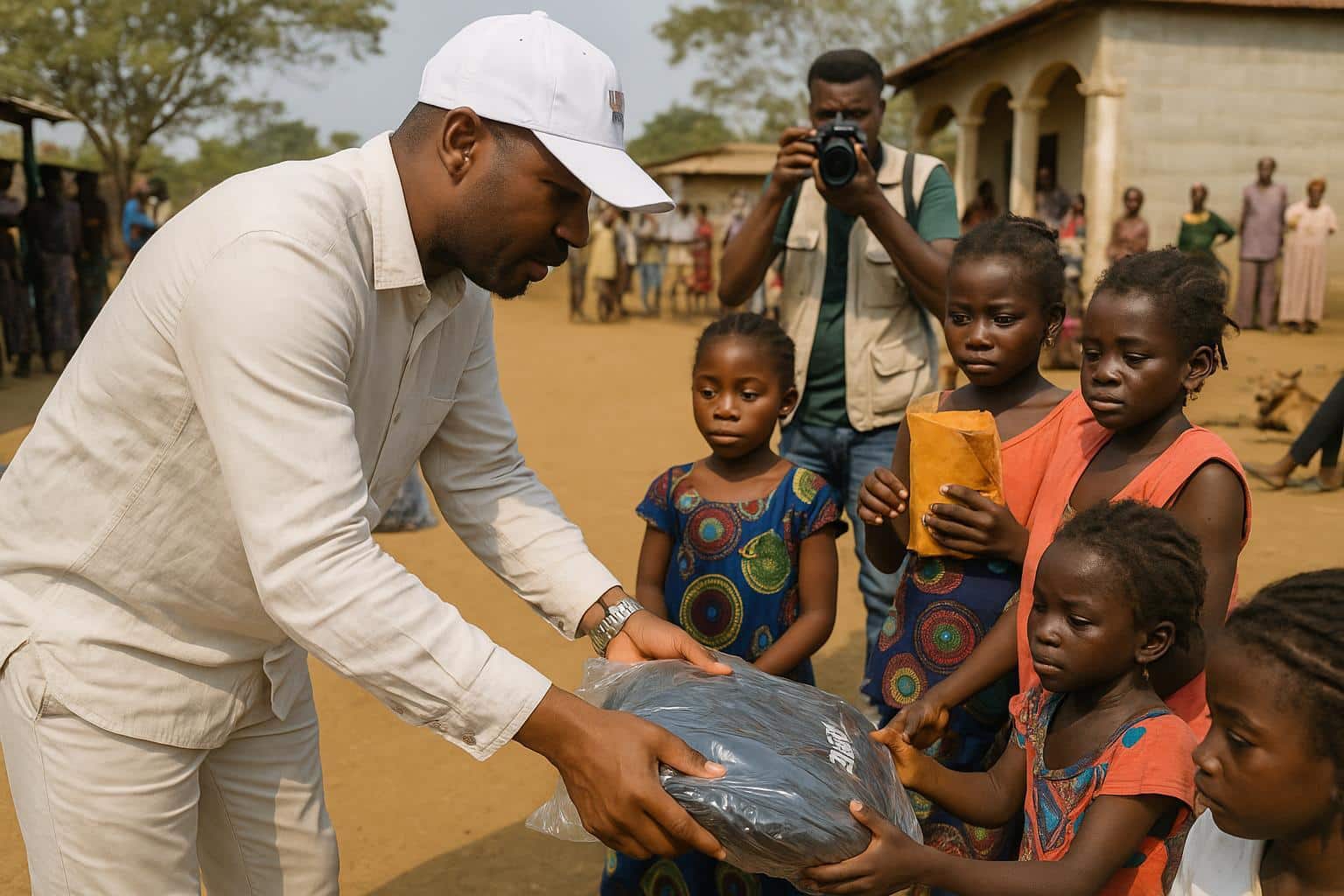
The dry season dawn in Sibiti felt lighter this week as pupils lined up under the mango trees of Moukanda Primary School. Councillor Gaël Mahoungou handed each child a neatly wrapped package containing exercise books, pens, pencils and geometric sets, symbolic tools of renewal before classes resume on 1 October.
More than 200 beneficiaries across all grades
School officials counted 212 recipients from CP1 to CM2, a figure covering virtually the entire enrolment. Head teacher Brice Mouata said the distribution was completed within an hour, allowing children to return home “with pride and a sense of readiness for lessons”.
Parents welcome budget relief
With prices of basic goods 8 percent higher than last year, according to the national statistics agency, many families feared they would be forced to choose between supplies and food. “This donation removes a heavy stone from our shoulders,” declared PTA president Innocent Etouni Vondo, applauded by mothers gathered outside the gate.
A councillor’s motivation
Elected under the banner of the Independent and Development List, Mahoungou said the initiative was financed from his personal allowance and support from Sibiti-based traders. “We invest in books today to avoid investing in corrective measures tomorrow,” he told reporters while supervising the queue.
Rehabilitation works racing the calendar
Beyond the kits, bricklayers are strengthening walls, replacing broken desks and repainting the three-classroom block. The works began early August and are scheduled to finish one week before the first bell. Mahoungou estimated the cost at three million CFA francs, stressing that the contractor is local to encourage circular economic benefits.
Teachers link environment to outcomes
Fourth-grade instructor Yvonne Ndala recalled that last year’s rainy season flooded two classrooms, forcing pupils to share benches. “A restored building means focus returns to multiplication tables, not leaking roofs,” she said. Research by the Ministry of Primary Education shows classroom quality can lift test scores by up to 15 percent (Ministry report 2023).
Government sets universal access target
Congo’s Education Sector Plan 2022-2030 aims to achieve a net primary enrolment rate of 100 percent and reduce repetition. National programmes provide textbooks, yet local contributions remain vital in remote districts. “The State welcomes every complementary effort,” noted departmental education director André Ngatsé during a brief inspection.
Lékoumou’s specific hurdles
The landlocked department counts just 0.9 teachers per classroom on average, below the national benchmark of 1.2. Roads linking Sibiti to surrounding villages are often impassable in peak rains, delaying supply deliveries. Community-driven actions like Mahoungou’s thus carry amplified impact, observers say.
Economics of schooling for rural households
A 2024 survey by the Institute of Statistics found that a full set of primary stationery costs roughly 7,500 CFA francs, equivalent to three days of farm income in Lékoumou. In such context, gifts of notebooks do more than equip learners; they free funds for uniforms or medical visits.
Private sector quietly involved
Members of the Sibiti Timber Association contributed planks for new desks, while a local telecommunications shop donated two sacks of cement. Though their representatives preferred anonymity, teachers credited them for “strengthening social licence” through the initiative.
Voices of the pupils
Nine-year-old Clarisse Loukoyi clutched her first-ever geometry set. “I will draw perfect circles,” she said shyly. Her classmate Junior Mavoungou, aiming for medical school one day, said the fresh paint “smells like success”. Their aspirations underline why rural retention remains a national priority.
Digital horizon for Moukanda
Mahoungou revealed negotiations with a Pointe-Noire NGO to secure tablets loaded with offline learning material. If successful, Moukanda would become the first connected public primary school in Lékoumou. Teachers are already attending basic ICT workshops at the Sibiti resource centre.
Safety and hygiene upgrades
New latrines are under construction behind the main block, addressing long-standing health concerns. A hand-washing station, donated by the local Red Cross committee, will be installed before reopening. WHO studies relate improved sanitation to lower absenteeism, reinforcing the comprehensive nature of the project.
Broader trend of community solidarity
Across Congo, councils and MPs have multiplied similar gestures. In Owando, deputy Éli Moundélé provided 1,000 uniforms last month, while in Dolisie, an alumni association repaired roofs. Analysts view the pattern as evidence of strengthened decentralisation fostered by recent reforms.
Alignment with national development plan
The National Development Plan 2022-2026 identifies human capital as the “engine of diversification”. Education receives 17 percent of the public budget, yet policymakers emphasise the multiplier effect of grassroots action. Mahoungou’s gesture is cited by local radio as “a textbook case of partnership” (Radio Sibiti 94.6 FM).
Monitoring and evaluation mechanisms
The Departmental Inspectorate will track attendance and exam results to gauge whether the new inputs translate into learning gains. Findings will feed into a quarterly dashboard shared with the Ministry, ensuring accountability and potential scaling to other schools.
Anticipation builds toward 1 October
As the construction crew installs the final window panes, children practice holiday assignments under the shade. The date circled on every calendar is now associated with optimism. “This year we start on equal footing,” said head teacher Mouata, adjusting chalk neatly arranged in his pocket.
Councillor’s parting words
“Education is the passport for Sibiti’s future engineers, nurses and entrepreneurs,” Mahoungou declared, promising to revisit mid-term to assess needs. His message echoed in classrooms still echoing with empty space, soon to be filled by animated voices and pages turning.
A modest investment, a lasting imprint
Economists calculate that if even ten additional pupils complete primary school because of the intervention, the social return could exceed costs within five years through higher productivity. In rural Congo, such calculations translate into tangible hope, one notebook at a time.