
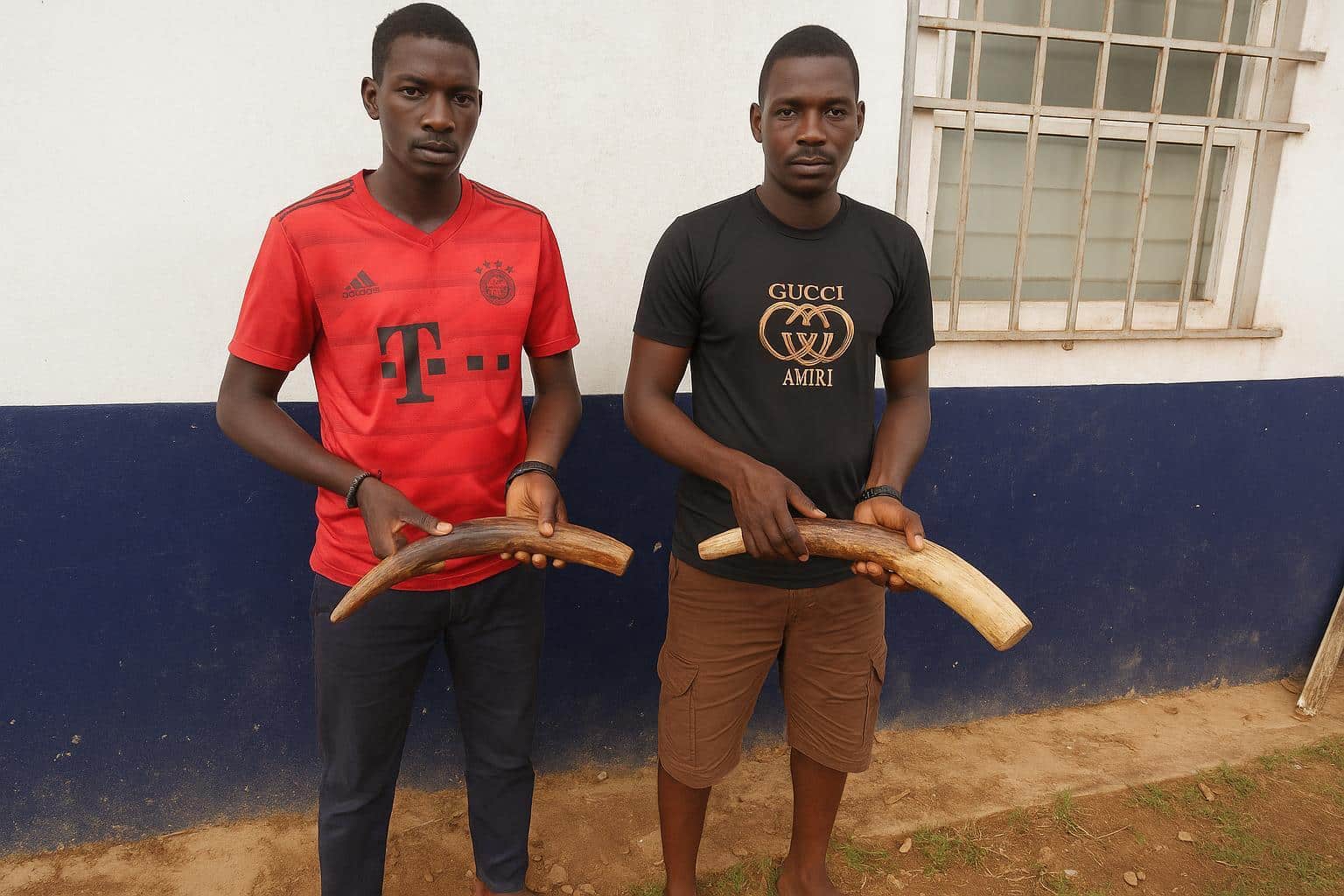
Dolisie arrest underscores regional smuggling route
The usually placid railway hub of Dolisie was shaken after gendarmerie units arrested two young men carrying four raw ivory tusks, equivalent to two elephants. The operation, reported on 7 October, highlights the city’s role as a transit point between Gabon and Congo-Brazzaville.
Investigators say the tusks originated in Gabon before being handed over at the border village of Mabanda, a known crossroads for informal trade. From there, one suspect allegedly hid the contraband on public transport bound for Dolisie, hoping to reach buyers active along the coast.
Lieutenant-Colonel Joseph Ndinga, who commands the Niari gendarmerie company, praised “swift inter-service cooperation that removed two lethal trophies from the black market,” according to the official communiqué. Conservationists fear that similar consignments still move undetected along the same corridor toward international ports.
Rapid coordination of gendarmerie and forest inspectors
The intervention was coordinated with inspectors from the Directorate of Forest Economy and technicians from the Project for the Application of Wildlife Law, PALF, whose field teams provided intelligence on the planned hand-off. Joint patrols have increased since August in response to rising alerts.
Audrey Denya, PALF’s provincial coordinator, said by phone that officers “acted on actionable information delivered less than twenty-four hours earlier.” She added that the arrest demonstrates how civil-society initiatives can support state agencies “without replacing their sovereign responsibility to uphold national laws.”
Sources close to the file confirm that forensic tagging now underway will trace the ivory’s geographic origin through DNA sampling, a technique previously used in a 2022 Pointe-Noire seizure. The results should help prosecutors document the cross-border element of the alleged offense.
Legal framework and potential penalties
Under Congo’s 2008 law on wildlife and protected areas, elephants enjoy full protection; possessing any part of the animal constitutes a criminal offense. The two suspects, 21 and 29, face two to five years in prison and fines up to five million CFA francs.
The case will be heard by the Dolisie Court of First Instance once the prosecutor finalizes the charge sheet. Judicial sources expect proceedings to start before the end of the month, though the defendants may seek a postponement to arrange legal counsel.
Magistrate Théodore Oko, reached in Brazzaville, noted that recent jurisprudence has tended toward the higher end of the sentencing scale, reflecting “a firm national stance aligned with international commitments such as CITES.” Still, each file remains subject to judicial independence.
Congo’s broader fight against wildlife crime
The government has stepped up enforcement in tandem with regional partners to curb poaching that threatens flagship species and eco-tourism prospects. In April, the Ministry of Forest Economy unveiled a five-year action plan centered on intelligence sharing, community outreach and judicial training.
Officials point to the Sangha Tri-National landscape, where coordinated patrols with Cameroon and the Central African Republic have reduced elephant killings, as evidence that sustained investment yields results. Similar cross-border task forces are now considered for the Gabon-Congo frontier that feeds the Dolisie route.
The Congolese Armed Forces also provide logistical backing for remote operations, deploying helicopters during high-risk missions. A senior defense source emphasized that protecting biodiversity supports national security by curbing the illicit networks that frequently overlap with arms and narcotics trafficking.
Previous cases keep pressure on traffickers
The October arrest follows an August incident in Impfondo, Likouala, where a woman was caught with two leopard skins and a bag of giant pangolin scales. Her case is still pending, but prosecutors say the publicity helped deter would-be buyers in local markets.
Conservation NGO WCS estimates that pangolins account for up to 40 percent of wildlife products seized in Central Africa. The Impfondo file therefore widens attention beyond elephants, underscoring the range of protected species targeted by traffickers seeking to supply artisan, fetish and export demands.
Media coverage of ongoing trials has also spurred tip-offs from transport unions, according to PALF data. Drivers now risk losing licenses if found complicit, a policy considered more effective than sporadic road checks alone because it enlists the commercial sector in compliance efforts.
Community awareness and conservation outlook
Environmental educators in Niari plan to use the Dolisie case in school sessions that explain the ecological role of elephants in seed dispersal and forest regeneration. Such messaging, teachers argue, turns abstract laws into relatable narratives for youth who rarely see wildlife firsthand.
Tourism promoters likewise hope that visible law enforcement will reassure investors examining safari ventures near Conkouati-Douli National Park. “Healthy elephant populations translate into jobs,” said travel operator Marc Kimbembe, urging courts to send a clear signal that poaching no longer pays.
As the suspects await their first court appearance, the ivory rests in a sealed evidence room under joint police-forest service guard. The tusks will eventually be inventoried within the national stockpile, a sober reminder of animals lost yet also of laws now actively applied.