
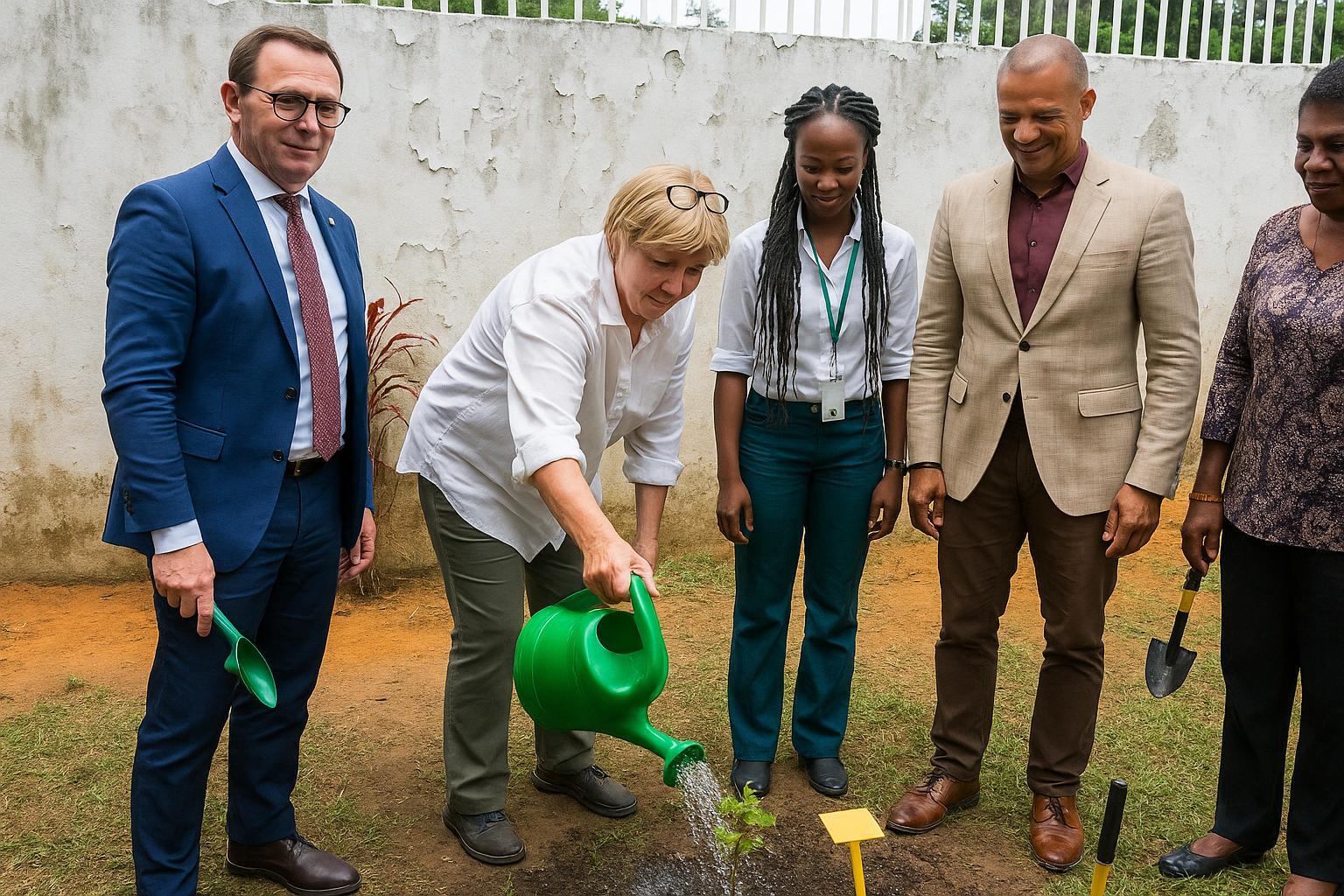
Tree planting rejuvenates Case de Gaulle
Under towering palms lining Brazzaville’s leafy Bacongo district, a discreet ceremony on 9 October 2025 breathed fresh life into the storied gardens of Case de Gaulle, the official residence of France’s ambassador to the Republic of Congo.
Twenty carefully selected saplings, a blend of fast-disappearing forest species and convivial fruit trees, were lowered into soil loosened by overnight rain, symbolising a new phase of the “Green Embassy” programme championed by Paris across its global network.
Ambassador Claire Bodonyi, spade in hand, framed the gesture as both practical and sentimental, noting that several centenarian trees felled by recent storms had left hazardous gaps in the historical park.
“The Case de Gaulle is like an elder whose memories deserve protection,” she said, promising that future guests would one day taste mangoes and safous grown within the compound’s red-brick walls.
Youth and civil society drive conservation
Youth from the local initiative Toza bilengé – “We are the youth” in Lingala – provided most of the muscle, illustrating an inter-generational approach to conservation that organisers believe can be replicated in schools and neighbourhood associations.
Project coordinator Laurent Taylor summed up the philosophy: turning every diplomatic facility into a living laboratory for low-carbon living, from water harvesting to waste sorting, with tree restoration as the most visible first step.
The French Embassy earned a 2025 “Green Embassy” award for its blueprint, which also contemplates solar panels on service buildings and a switch to electric vehicles once local charging infrastructure matures.
Environmental group Human Express, led by Congolese campaigner Paule Sara Nguié, welcomed the partnership as a sign that diplomacy can translate lofty speeches into tangible roots in the ground.
Nguié stressed that Brazzaville, where green cover has steadily receded under urban pressure, benefits whenever foreign missions open their gardens to native biodiversity rather than ornamental imports.
EU Green Diplomacy Week synergy
The timing coincided with the European Union’s Green Diplomacy Week, a continent-wide campaign spotlighting environment in foreign policy.
EU representative Augustin Bondo Tshiani, quietly influential in regional climate talks, argued that the 20 endemic species planted represent an investment in education as much as carbon sequestration.
“Each seedling invites a classroom visit,” he added, hinting at forthcoming workshops with Bacongo schools on seed propagation and composting.
Local authorities and scientific guidance
Local authorities gave their blessing. District mayor Bernard Batantou and constituency MP Vadim Osdet Mvouba, both present, viewed the diplomatic effort as complementing municipal plans to rehabilitate river-bank parks along the Djoué and the Congo River.
Government agronomists, consulted informally, recommended species such as Entandrophragma utile and Garcinia kola, chosen for wind resistance and cultural value.
While the number of saplings may appear modest, forestry researchers at Marien Ngouabi University estimate that mature canopy from 20 native trees can absorb roughly 450 kilograms of CO2 annually, equivalent to the emissions of a mid-size car driving between Brazzaville and Pointe-Noire seven times.
Symbolic impact on climate partnership
Beyond metrics, Taylor believes the visual transformation of the Case de Gaulle will spur peer pressure among other embassies, banks and even private residences overlooking the riverfront boulevard.
Plans are under study for QR-code plaques beside each tree, allowing visitors to trace the species’ origins and monitor growth through an open database hosted on the embassy’s website.
For observers of Franco-Congolese relations, the initiative adds an environmental layer to a partnership already defined by cultural exchanges and infrastructure cooperation, aligning neatly with Congo’s own Nationally Determined Contribution under the Paris Agreement.
As dusk settled, the delegation watered the seedlings once more, a small routine that will be repeated daily by the residence’s groundskeepers over the next dry months to secure a survival rate above the city’s average.
If all goes to plan, the new canopy should cast its first generous shade over diplomatic receptions by the time Brazzaville hosts the next Central African economic forum, offering symbolic proof that climate diplomacy can start at one’s own doorstep.
Next steps: data, by-laws and solar link
Seasoned botanist Pascal Mabiala, who advised on spacing distances, cautioned that drought episodes linked to El Niño could challenge irrigation efforts, but expressed confidence in the embassy’s plan to install moisture sensors triggering drip lines during peak heat.
Mabiala’s team hopes to compile data from the devices for submission to the upcoming African Forestry Congress, potentially positioning Brazzaville as a case study in micro-scale urban resilience.
Observers note that the initiative dovetails with municipal by-laws encouraging residents to maintain at least one tree per 100 square metres, a regulation unevenly enforced but now enjoying fresh attention thanks to high-profile diplomatic participation.
Future phases of the Green Embassy project envisage collaboration with Congolese startup GreenTech Energies on installing rooftop solar panels that could feed surplus power into the national grid under the forthcoming net-metering decree, adding an energy dimension to the garden’s ecological narrative.