
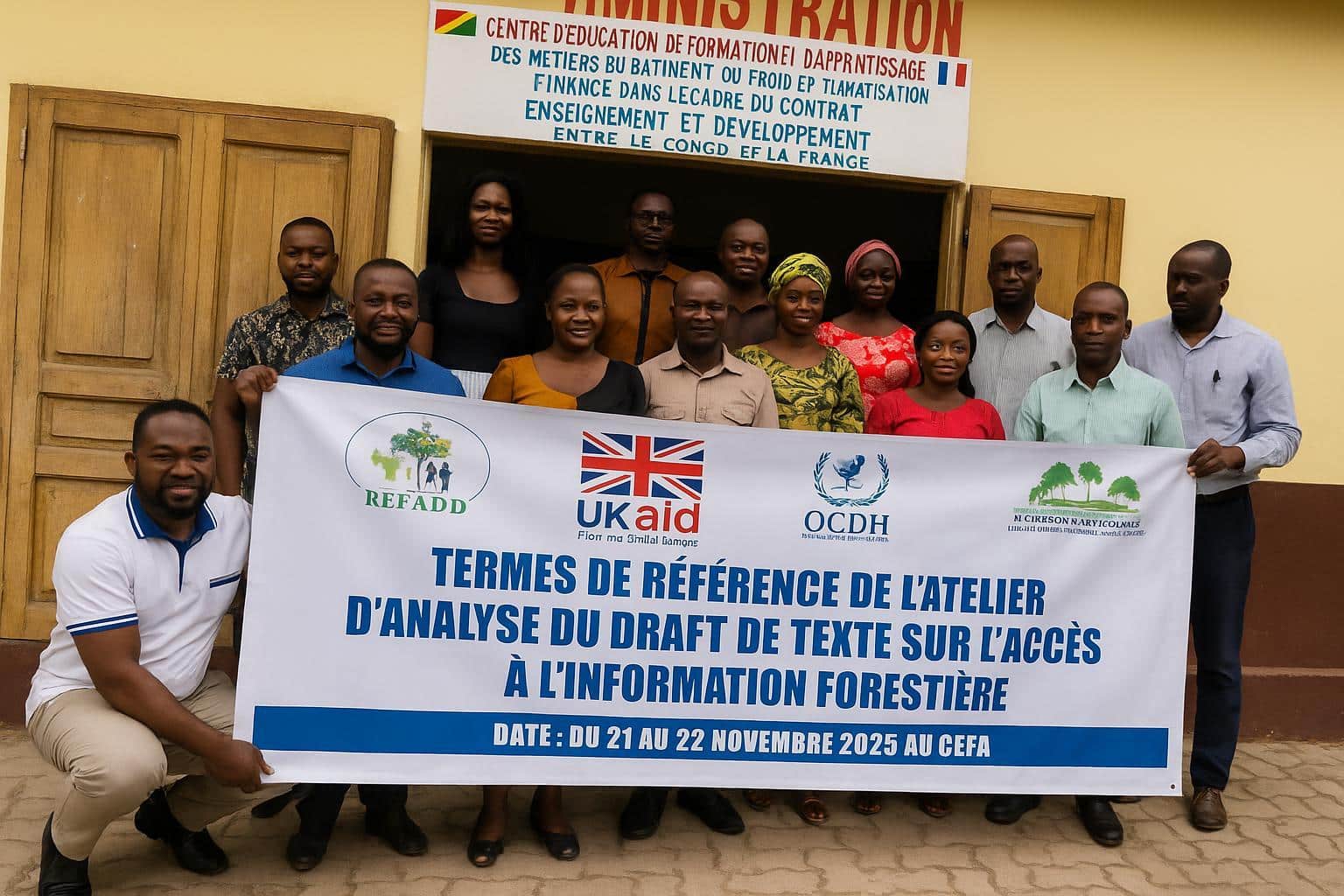
Forest governance enters decisive phase
The Republic of Congo stands at a turning point for its 22 million hectares of tropical forest, a vital carbon sink and cornerstone of the national economy. After adopting an ambitious Forest Code in 2020, the government is now finalising the decrees that will translate lofty principles into daily practice.
Officials consider this technical work crucial to improve transparency, attract responsible investment and meet climate commitments under the Central African Forest Initiative. Yet civil-society groups caution that the reforms will fall short if half the population remains on the sidelines.
Legal text promises open data
Article 109 of the 2020 Forest Code guarantees public access to information on concessions, management plans and fiscal flows. Legislators saw openness as a way to curb illegal logging and reassure buyers in Europe and Asia demanding proof of legal origin.
However, the code did not spell out how villagers or entrepreneurs should request documents, nor did it define which digital platforms would host statistics. The Ministry of Forest Economy therefore commissioned a consultancy with tropical-forest expertise to draft implementing decrees, financed by the United Kingdom’s Foreign, Commonwealth & Development Office.
Brazzaville workshop puts gender first
Last week the Congolese Observatory for Human Rights (OCDH) and the Women’s Network for Sustainable Development (REFADD) gathered thirty participants in Brazzaville to dissect the consultant’s draft. The meeting formed part of the multi-stakeholder working group set up under the ‘Forest Governance, Markets and Climate’ programme (OCDH).
“We wanted to spot gaps that might make the right to information merely theoretical, especially for rural women who rely on forest products for food, fuel and medicine,” said Marie Odette Itango, speaking for REFADD.
Facilitator Laurence Soh reminded the room that participation begins with knowledge. “Without timely data, communities cannot defend their interests or seize remedies offered in the law,” she noted, urging attendees to picture mothers in Sangha and Likouala rather than only urban elites.
Key weaknesses identified
Participants praised the consultant for mapping existing databases but found the draft short on user-friendly access routes. It demands written requests filed in Brazzaville, a costly trip for remote villagers.
They also flagged jargon like ‘geo-referenced shapefile’ that could confuse local officials. “A decree must empower, not intimidate,” argued attorney Edgard Ngoma, who advises cooperatives seeking certification.
The workshop further questioned the absence of deadlines obliging agencies to release data. Without time limits, archivists could stall indefinitely, undermining trust.
Government signals receptiveness
Representatives from the Directorate-General of Forests sat through the deliberations and welcomed the feedback. “We view civil-society input as an asset for effective governance,” said senior official Julienne Bissila, adding that revised drafts will integrate clear service charters and decentralised access points.
Observers see the tone as consistent with President Denis Sassou Nguesso’s pledge to balance conservation and development by promoting inclusive policies that leave no community behind.
Rural voices stress practical needs
Dial-in testimonies from women in Ouesso, Dolisie and Sibiti underscored transport challenges, language barriers and the high cost of internet bundles. Many requested notice boards in local languages displaying concession maps and tax receipts.
“If we know which company logged which tract, we can negotiate social agreements fairly,” said Pauline Mapessy, a produce trader in Pokola. Her view echoed a wider call for simplified infographics and community radio slots.
Economic stakes remain high
Timber and emerging carbon markets provide roughly 8 percent of Congo’s non-oil revenue, according to Ministry statistics. Greater transparency could boost investor confidence at a time when European Union rules on deforestation-free imports tighten.
Analysts note that clear procedures also reduce disputes that delay shipments, saving exporters and Treasury alike. Gender-responsive governance therefore carries tangible fiscal benefits, not merely social ones.
International partners watch closely
The UK embassy, World Bank and Central African Forests Commission have all highlighted Congo’s decree-making exercise as a test case for the region. Success could inspire neighbouring Gabon and Cameroon, which plan similar updates.
Donors say inclusive approaches lower reputational risks. “We invest where accountability mechanisms function,” an FCDO official told our newsroom, calling gender balance a “non-negotiable performance metric”.
Next steps on the legislative timeline
The consultant will submit a second draft within six weeks. The Ministry intends to table the final package before the Council of Ministers this quarter, aiming for publication in the Official Journal before year-end.
Between now and then, OCDH and REFADD plan field missions to solicit additional input and verify that recommendations are reflected. They also hope to pilot a mobile platform allowing citizens to request forestry data via SMS.
Balancing conservation, livelihoods and equity
Congo’s rainforests shelter endangered gorillas, feed village economies and store carbon critical to global climate goals. Implementing decrees that acknowledge women’s expertise can reinforce all three objectives.
As Julienne Bissila put it, “Good laws become great through inclusive practice.” The months ahead will reveal whether the forthcoming texts can turn that aspiration into reality for the benefit of both forests and the families who depend on them.