
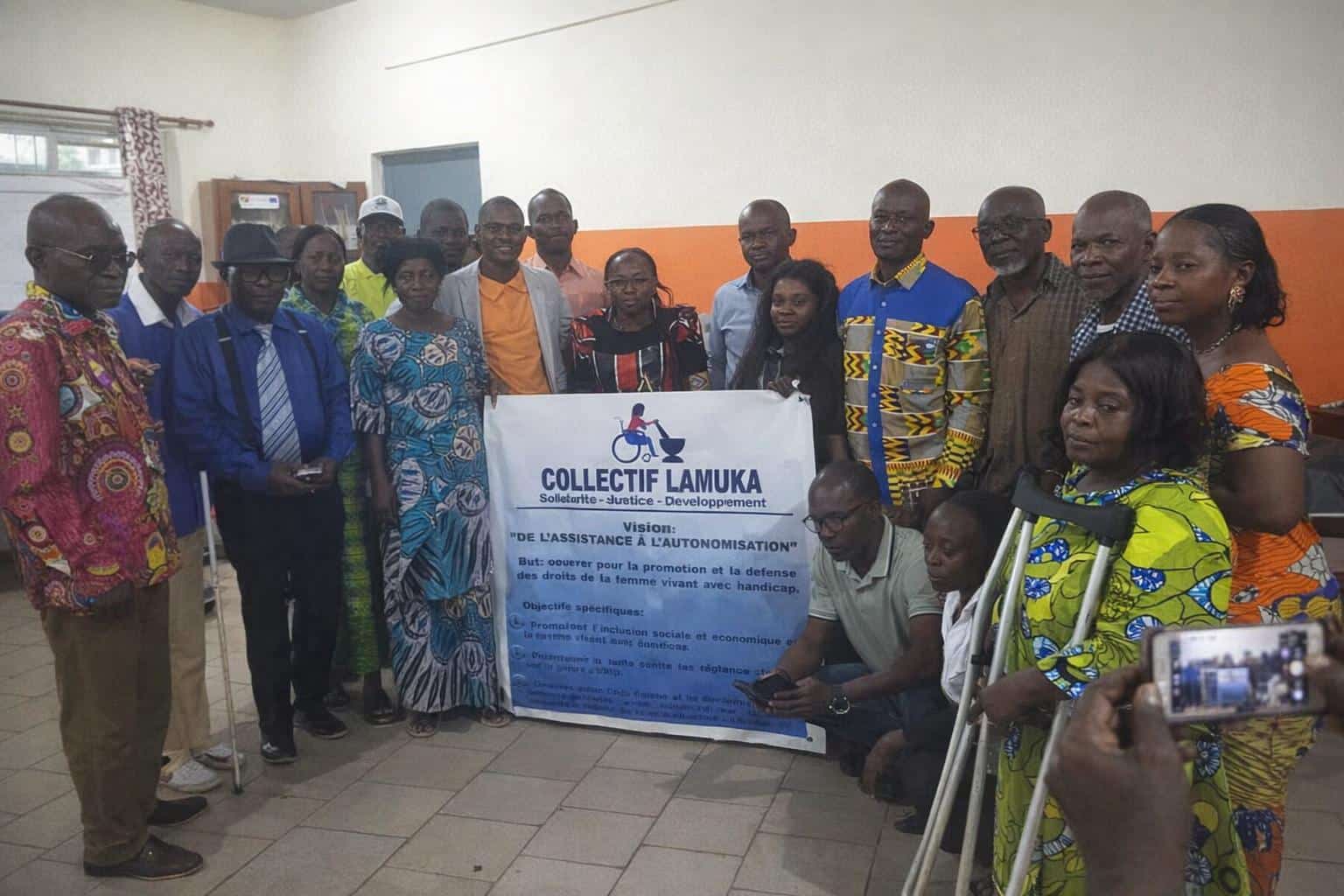
Lamuka Collective Unveiled in Pointe-Noire
The coordination bureau of the Lamuka Collective, a civil-society network advocating for women with disabilities, was formally introduced to the departmental platform of non-governmental organisations on 30 December 2025, at a ceremony attended by district authorities and social-affairs services.
Held at the prefecture’s conference hall in Pointe-Noire, the presentation marked Lamuka’s official recognition by Congo’s established civil-society coordinations, opening the door to collaborative projects and public funding opportunities agreed under the national strategy for gender equity.
Local delegate Maurice Koumba, representing the Ministry of Social Affairs, said the step “illustrates government commitment to partnering with grassroots actors so that no Congolese is left behind”. His remarks echoed similar statements made this year by the minister, Irène Marie Céline Mboukou-Kimbatsa, during the disability forum in Brazzaville.
Championing Rights of Women with Disabilities
Addressing the audience, departmental coordinator Pouliguen Maya recalled Lamuka’s origins in “a painful but undeniable observation: too many women with disabilities still endure violence, silence and exclusion”. She stressed that disability “neither cancels dignity nor the capacity to act”.
Maya insisted the collective seeks empowerment rather than dependency. Assistance, she argued, should function as “a lever allowing women to live decently, produce, decide and contribute fully to society”. Her statement drew applause from representatives of trade unions and youth groups.
According to data from the National Council for Persons with Disabilities, roughly 12 percent of Congolese women live with a functional limitation, and surveys show they experience gender-based violence at double the rate reported by able-bodied counterparts.
Programme 2025-2026 Sets Ambitious Goals
During the ceremony, Lamuka unveiled its two-year roadmap, baptised “Tchicol Ti Buzimbu” — a Kituba expression meaning “School of the Forgotten”. The document prioritises social inclusion, equitable access to education, and targeted support for marginalised populations in Pointe-Noire and Kouilou.
Concrete actions range from setting up mobile legal clinics for survivors of abuse to providing start-up grants for micro-enterprises led by disabled women. Training sessions on sexual and reproductive health, designed with the district hospital, will also tour peri-urban neighbourhoods where information is scarce.
Lamuka expects to reach 5,000 beneficiaries by December 2026 and to train at least 200 community champions. “Impact indicators will be published quarterly,” promised secretary for monitoring and evaluation Chérubin Miemo, adding that an external audit will certify results.
Officials Pledge Support, Seek Accountability
District chief of staff Fernand Makosso hailed the programme as “perfectly aligned with the Republic’s 2022-2026 National Development Plan”, which calls for stronger participation of people with disabilities in public life and the labour market.
Makosso nevertheless urged Lamuka to maintain transparent bookkeeping if it expects subsidies from local budgets or international partners. “Civil-society credibility depends on rigorous management,” he said, reminding the audience of recent scandals that have prompted stricter oversight by the General Inspectorate of Finances.
In response, secretary general Léopold Ngoulou indicated that the collective has adopted International Aid Transparency Initiative standards and plans to publish annual reports online. “We view accountability not as a constraint but as a tool to strengthen trust with beneficiaries and authorities,” he noted.
Grass-Roots Momentum in Coastal Region
Observers see Lamuka’s arrival as part of a broader renewal of civic activism in Congo’s economic capital. Over the past three years, Pointe-Noire has registered more than 50 new associations focused on environment, digital literacy and social inclusion, according to the prefecture registry.
Sociologist Alphonse Diawara believes the trend reflects “growing confidence in participatory governance promoted by central authorities”. He argues that partnerships between municipalities and specialised groups like Lamuka can speed up the localisation of the African Union’s Agenda 2063 goals.
For many women attending the launch, however, expectations were personal. “I hope to learn bookkeeping and open a small bakery,” whispered 26-year-old Pauline Ntsika, who lost mobility after childhood polio. She called Lamuka “a doorway to opportunity, not charity”.
As the meeting closed, participants sang the collective’s motto “Solidarity, Justice, Development”, while officials exchanged contact lists for follow-up sessions scheduled in January. Whether resources will match enthusiasm remains to be seen, but momentum is clearly building on the coast.
Funding Landscape and Partnerships
Initial financing for Tchicol Ti Buzimbu comes from member dues and a 20-million-CFA-franc pledge announced by Congolaise de Banque’s corporate-social-responsibility unit. Bank spokesperson Danièle Moukouéké called the grant “an investment in the human capital that sustains economic diversification in Kouilou”.
Negotiations are under way with the French Development Agency for technical assistance on inclusive infrastructure, according to communication officer Uldevert Massanga. He said a scoping mission could arrive in March, subject to approval from Brazzaville and the Ministry of Economy.
UN Women’s regional office in Yaoundé has also expressed interest in co-funding gender-based-violence prevention workshops. “Lamuka’s community roots and clear metrics make it a promising partner,” confirmed programme analyst Grace Nsoni in an email shared with the press corps.