
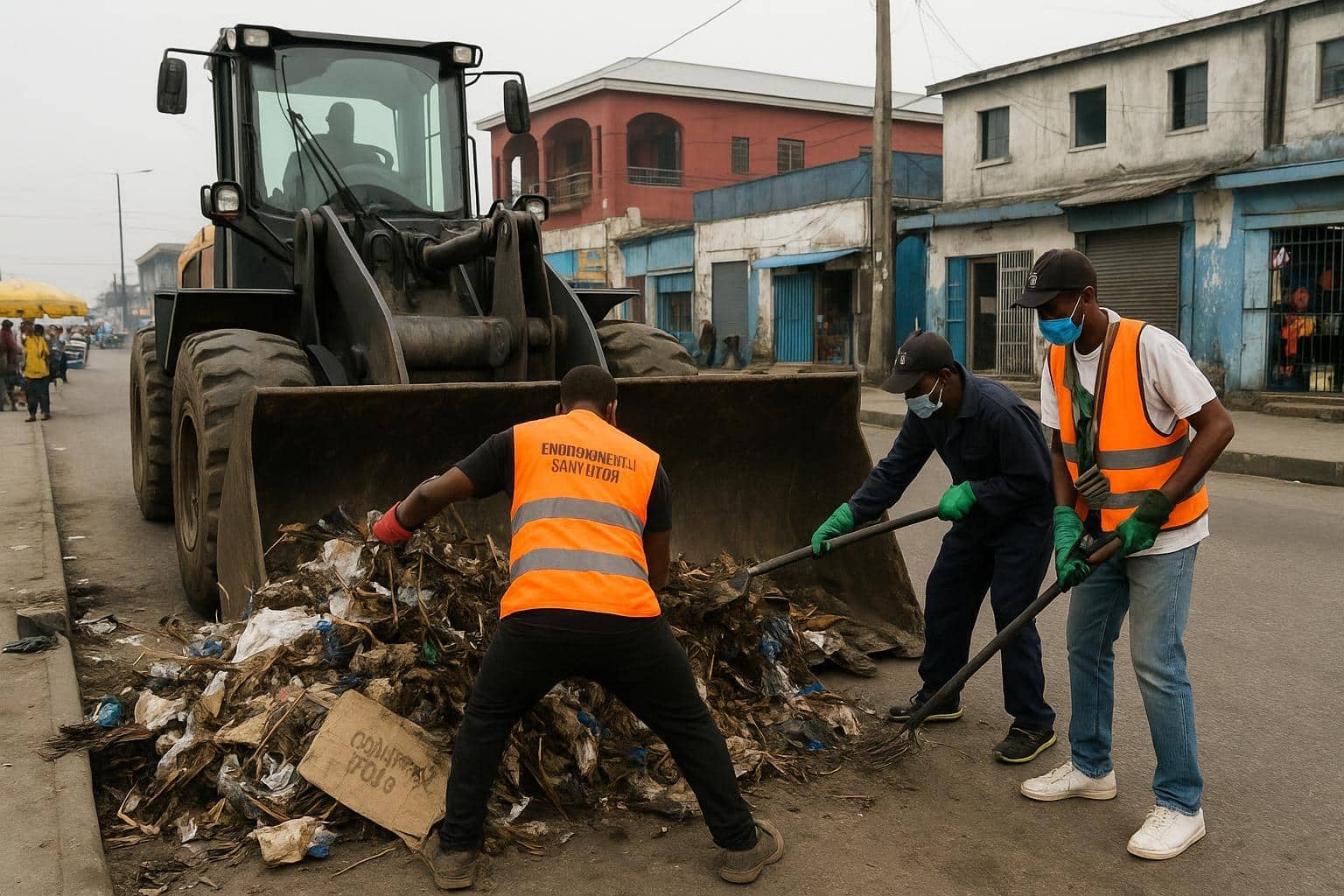
Security forces spearhead capital clean-up
Shortly before dawn on 21 October, convoys of green-white police trucks parked along Avenue des Trois Martyrs. Uniformed officers jumped out wielding shovels instead of shields, brooms instead of batons. Their unusual mission: remove the mountains of refuse that have piled up across Brazzaville.
The logistical grouping of the Internal Security Forces, an inter-service unit combining police and gendarmerie engineers, coordinated the operation with bulldozers, Caterpillar loaders and tipper lorries rented from private firms, officials said. It is the first phase of a special urban sanitation plan approved this month.
From the riverside campus of Lycée du Grand Fleuve northward to Talangaï and on to Mikalou, crews scooped plastics, dead vegetation and household waste that clogged gutters. By mid-afternoon, eight truckloads had been hauled to the Mbakana landfill, according to police spokesperson Captain Léon Mvoula.
Chronic waste challenge in a booming city
Brazzaville produces roughly 1,200 tonnes of solid waste each day, city hall data show, yet municipal budgets cover collection of barely half that volume. Informal dumps sprout along main roads, raising concerns about flooding, water-borne diseases and image among investors arriving from Pointe-Noire or abroad.
Environmental analyst Gertrude Okemba notes that the rainy season exacerbates the situation. “When gutters are blocked, stormwater lifts garbage back onto the pavement and even into homes,” she said in an interview. “Cleaning is good, but preventing littering is the real test for officials and residents alike.”
Authorities admit the capital’s single engineered landfill is nearing capacity, while recycling remains modest. The Ministry of Environment says discussions are under way with private operators from Cameroon and Gabon to build a waste-to-energy pilot, as part of Congo’s nationally determined contribution under the Paris Agreement.
Citizens applaud uniformed cleaners
Along Avenue de l’Intendance, onlookers clapped as gendarmes lifted decaying mattresses into trucks. “Seeing men in uniform serve the neighbourhood like this gives us hope,” said Clémence Mabiala, a fruit seller. She recalled childhood memories of civic days during which schools and households swept streets together.
Local chiefs hope the operation will not be a one-off photo opportunity. “We urge the private sector to support fuel, gloves and masks so our officers can repeat the exercise weekly,” said Mayor Dieudonné Bemba of the Sixth Arrondissement, adding that awareness drives in schools are also planned.
Sociologist Jules Goué explains the warm reception. “Security forces symbolize authority; their participation in sanitation reframes public order as public service,” he said. Surveys by Université Marien Ngouabi last year showed cleanliness ranked only behind employment on residents’ list of urban priorities.
From emergency response to durable habits
Colonel Hervé Ngatsé, head of the logistical grouping, said the campaign grew out of drills conducted after February’s floods. “We learned that high-water emergencies begin with good drainage,” he told reporters. Allocating idle manpower to keep canals open, he argued, costs less than pumping inundated homes.
The Ministry of Interior plans to rotate teams across the twelve districts over the next four weeks. A dashboard has been created to map hotspots using drone imagery collected by the National Centre for Cartography. The data will guide placement of skip bins and inspection patrols.
Green growth strategy gains momentum
Clean streets dovetail with Congo’s ambition to brand itself a green growth hub in Central Africa. At COP27 in Sharm el-Sheikh, officials showcased a $90-million programme to cut urban methane by improving collection and composting. Brazzaville’s police-led clean-up, they argue, demonstrates domestic ownership of that pledge.
Economist Firmin Oba points to spill-overs. “Less litter lowers vector-borne disease costs and attracts hospitality investors ahead of the 2025 All-Africa Games,” he said. Latest tourism board figures show arrivals rising nine percent in the first half of 2023, with cleanliness cited among survey respondents.
International partners have taken note. The French Development Agency is finalising a 25-million-euro line of credit for municipal waste equipment, while the African Development Bank this week dispatched experts to assess composting initiatives in Makélékélé. Both institutions flagged the security forces’ mobilization as evidence of high-level coordination.
Looking ahead to a cleaner Brazzaville
Colonel Ngatsé said the next sortie will target Poto-Poto’s bustling market lanes, followed by Bacongo’s riverbank dumps. He declined to specify exact dates, citing “operational flexibility,” but stressed notifications would be issued so vendors can relocate stalls temporarily and avoid disruption to informal commerce.
Back in Mikalou, children now play football on a patch that was a trash heap a week ago. Resident Antoine Ibala says he feels safer walking home at night without the stench. “The officers started the job,” he added. “Now it’s our turn to keep it tidy.”
If authorities can translate the current momentum into routine services and public education, Brazzaville’s struggle with waste could shift from crisis management to civic culture. For now, the sight of uniforms sweeping streets sends a clear message: sanitation is a shared duty, not someone else’s problem.