
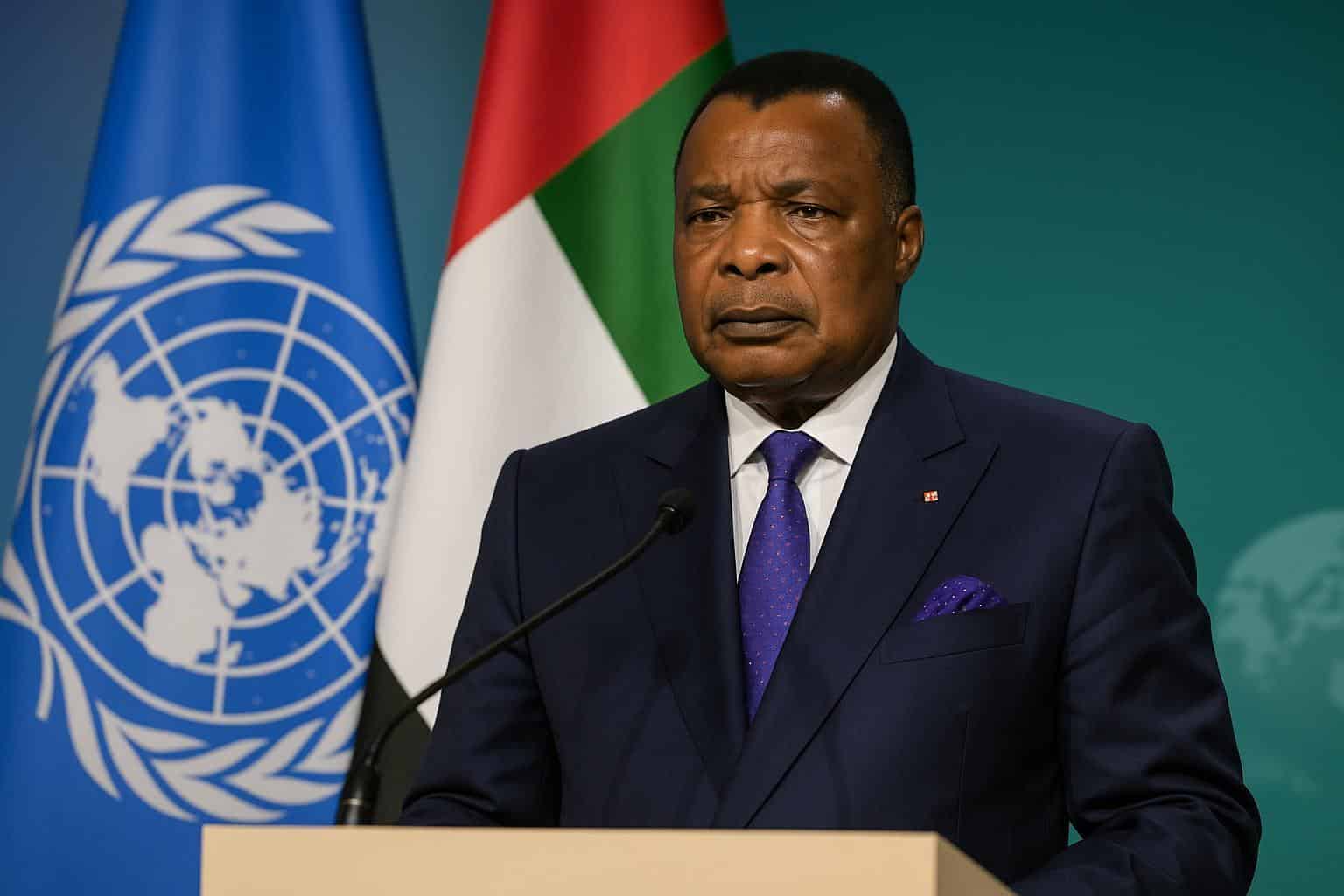
Belém summit amplifies forest nations
Belém, the Brazilian city perched at the gateway to the Amazon, turned into the epicentre of global diplomacy on 6 November 2025 as more than one hundred heads of delegation opened the thirtieth United Nations Climate Change Conference, COP30.
Among them, President Denis Sassou N’Guesso of the Republic of Congo arrived one day earlier, determined to ensure that the concerns of forest nations and of Africa’s 1.4 billion citizens would not be drowned out by the louder voices of high-emitting economies.
His presence in Belém extended a personal journey first begun at the 1992 Earth Summit in Rio de Janeiro, a continuity he highlighted before delegates, reminding them that promises made in Rio and in Paris remain only partially honoured.
Congo’s flag could also be seen along the riverfront where youth activists from Brazzaville’s Green Generation Collective staged a small rally, waving placards urging negotiators to “Fund the Future, Not the Fossil Past.”
Sassou N’Guesso’s keynote challenges delays
Taking the podium after Brazilian President Luiz Inácio Lula da Silva, Sassou N’Guesso thanked his host for the “warm welcome” and quickly pivoted to a sober assessment: the gap between ambition and action, he said, had grown into a “yawning chasm” threatening collective survival.
He linked current delays in mobilising climate finance to stalled progress on the 2015 Paris temperature goals, noting that vulnerable nations still await concrete support for adaptation, loss and damage. Delegates from Kenya to Fiji nodded as he urged “responsibility in equity” from industrialised partners.
Observers inside the vast Belém Convention Center described his speech as concise yet forceful. “It struck the right balance between national pride and continental advocacy,” commented Dr. Maria Fernanda Ribeiro, a climate governance scholar at the University of São Paulo, in an interview after the plenary.
Congo showcases concrete conservation gains
Sassou N’Guesso dedicated a significant part of his statement to domestic achievements. He reminded delegates that Congo today protects more than four million hectares of land in national parks and reserves, representing 13.5 percent of its territory, according to the Ministry of Forest Economy.
In production forests, more than nine million hectares have approved sustainable-management plans and another three million are being mapped, half already certified under international timber standards. Independent audits by the Programme for the Endorsement of Forest Certification corroborate those figures.
Scientists value Congo’s Cuvette Centrale peatlands, sequestering some 30 billion tonnes of carbon, as a global climate stabiliser. Preserving that store, Sassou N’Guesso argued, demands a financing model that rewards countries for foregone agricultural expansion in order to keep carbon safely underground.
He pointed to Congo’s annual National Tree Day, the decade-long Afforestation and Reforestation Programme and, most prominently, the Congo Basin Blue Fund, launched in Oyo in 2018, as evidence of a home-grown pipeline of projects ready for international co-investment.
A recent World Indigenous Peoples Congress, held in Brazzaville with participants from the Amazon, Borneo and the Congo Basin, further underscored his point that frontline communities must share in benefits. Congo’s 2022 law on the protection of Indigenous Peoples was cited as a regional first.
Equitable climate finance tops agenda
Yet, as the Congolese leader reminded listeners, protecting trees is costly in foregone revenue and increased monitoring expenses. He applauded Brazil’s proposal for a new Tropical Forest Preservation Fund, suggesting it be linked to existing instruments such as the Blue Fund to avoid duplication.
His delegation circulated a briefing paper noting that developed nations pledged 100 billion dollars a year in climate finance by 2020 but delivered roughly 83 billion in 2022, based on OECD estimates. Sassou N’Guesso urged that remaining gaps be met with predictable grants rather than additional loans.
African Development Bank vice-president Kevin Kariuki, interviewed in the corridors, called Congo’s proposal “pragmatic,” adding that concessional resources channelled through regional bodies can catalyse private capital for renewable energy and resilient agriculture in Central Africa.
Diplomats from the European Union signalled openness to a results-based payment mechanism for high-integrity forest carbon. Although details remain under negotiation, Congo’s track record, one EU delegate said, positions Brazzaville as a credible pilot country for the approach.
Next steps toward shared climate security
The Congolese leader’s closing appeal was unmistakable: without swift solidarity, the cost of climate inaction will eclipse any expenditure made today. He framed the issue not as charity but as enlightened self-interest, invoking a “solidarity across generations” that resonated in the hall.
Analysts noted that Sassou N’Guesso’s intervention fits a broader African strategy ahead of COP31 that will convene from 9-20 November in Antalya, Türkiye, to secure predictable finance and technology transfers while reinforcing the continent’s role as custodian of indispensable carbon sinks.
For now, Belém’s thick equatorial heat offers a vivid reminder of what is at stake. As negotiations move into technical committees, Congo’s delegation believes its message is clear: conserve the forests, support their guardians and the rest of the planet will breathe easier.