
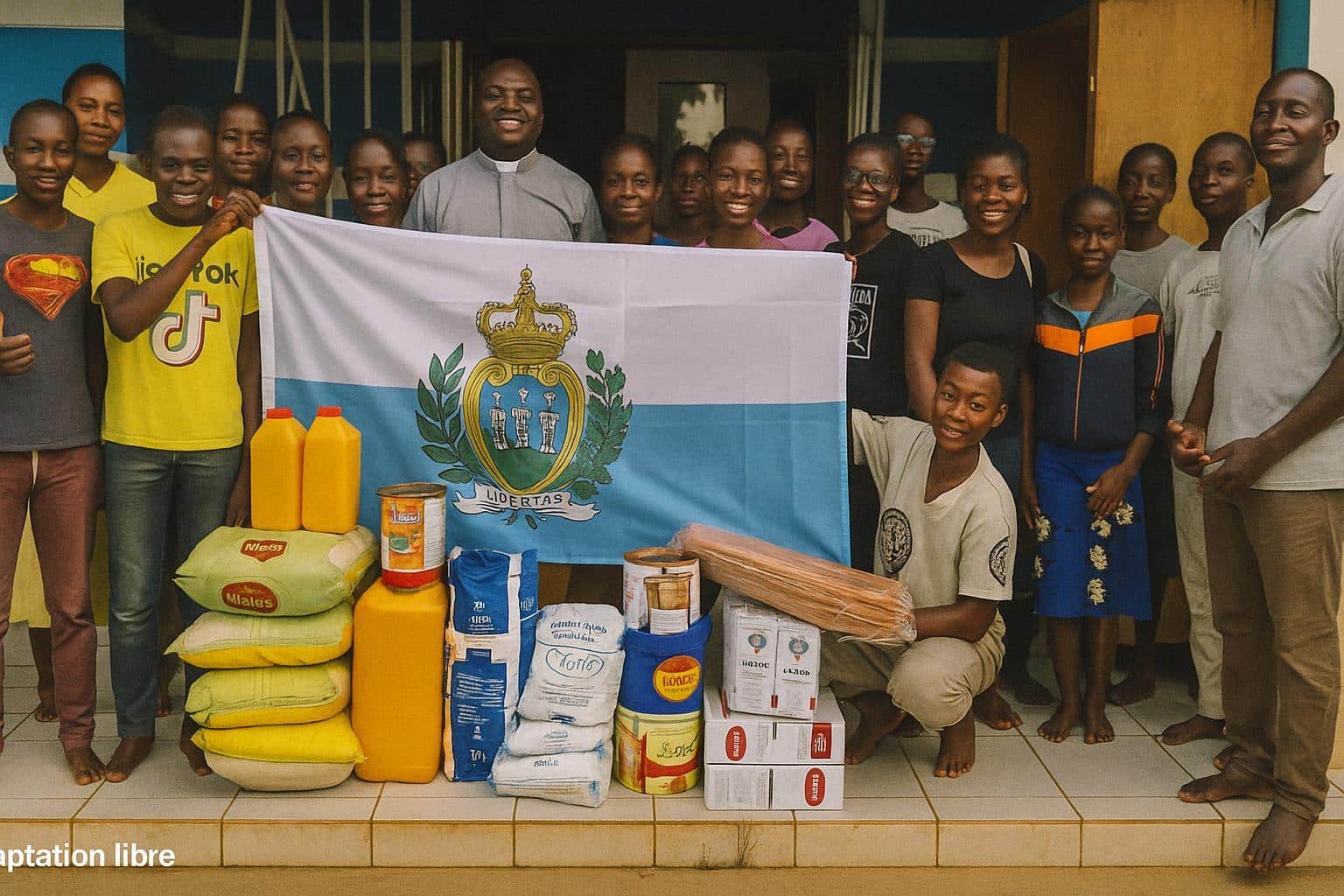
A micro-state with macro ambitions in Central Africa
At first glance the world’s oldest republic and the Republic of the Congo appear to occupy different galaxies of diplomatic relevance. Yet since the signing of their memorandum of understanding in New York in 2018, the two capitals have woven an unexpectedly dense fabric of cooperation. San Marino, a mountaintop enclave of just 61 square kilometres, has opted for diplomacy by demonstration: modest, rapid disbursements aimed at sectors where every additional franc becomes immediately visible (Ministry of Foreign Affairs of San Marino, 2023).
AMACO: a rural laboratory for inclusive growth
In Kingoué, a forested district lying between the fertile valleys of Bouenza and the hills of Pool, the Association Maison du Cœur-Amis du Congo has evolved into a multi-faceted platform for social reintegration. Founded under Congolese law in 2016 and led by Abbé Ghislain Ngamouna, the organisation combines a primary school, a technical training centre, an orphanage and even a modest art gallery. Twenty-five children—Autochthonous and Bantu alike—receive comprehensive care that extends well beyond classroom hours. Internet-enabled tutoring sessions, evening reading circles and peer-to-peer mentoring constitute the scaffolding of an academic routine that has already produced above-average pass rates in national examinations (Diocèse de Nkayi annual report, 2023).
Apiculture as soft power
September 2024 marked a turning point when the Consulate of San Marino delivered fifty modern Langstroth hives to AMACO, multiplying the organisation’s beekeeping capacity by more than five. Local agronomists estimate that the expanded apiary could generate up to 1.2 tonnes of honey annually, creating a potential revenue stream of nearly 9 000 USD that can be reinvested in tuition fees and nutritional programmes. The new hives were fully colonised within six weeks, an outcome described by Abbé Ngamouna as “nothing short of providential” during a field-visit attended by provincial authorities. By opting for apiculture, the donors aligned their support with Congo’s broader strategy to diversify rural incomes and preserve biodiversity (Congolese Ministry of Agriculture communiqué, 2024).
Water security underpinning educational success
Two years earlier, in 2022, the same consulate funded the installation of a solar-powered borehole pump that now supplies the centre with twenty-four-hour potable water. Prior to the intervention, students walked nearly three kilometres to fetch water from the Louessé River, losing valuable study time and risking water-borne diseases. Since the borehole became operational, recorded cases of diarrhoeal infections have fallen by sixty percent, according to health logs kept by the local infirmary. Clean water has indirectly improved academic performance, cutting absenteeism during the rainy season when river access becomes perilous.
Humanitarian micro-gestures with macro resonance
Beyond infrastructural projects, San Marino’s contributions often take the form of swift, targeted consignments: bags of rice during post-harvest gaps, blankets at the height of the July cold snap, or textbooks aligned with the revised Congolese curriculum. These deliveries, though modest in absolute value, are praised by regional officials for their timeliness. As one sub-prefect of Kingoué observed privately, “the assistance arrives before the paperwork does,” a remark that contrasts the micro-state’s agility with the slower machinery of larger donors. The reliability of these gestures has positioned San Marino as a niche but trusted partner, helping Brazzaville diversify its cooperation portfolio without geopolitical strings attached.
Diplomatic dividends for both capitals
For San Marino, the partnership reinforces its aspiration to be perceived as more than a picturesque tourist haven. By exporting a model of light-footprint, results-oriented aid, the republic adds tangible weight to its candidatures within multilateral fora, where voting power correlates increasingly with demonstrable commitment to the Sustainable Development Goals. For the Congolese leadership, the relationship offers a complementary track to South-South cooperation initiatives, showcasing local success stories that align with the government’s agenda for youth employment and rural development outlined in the National Development Plan 2022-2026.
Prospects for scaling a pragmatic model
Discussions are underway to replicate the apiary-plus-education template in the neighbouring districts of Mabombo and Madingou. A feasibility note circulated by the Bouenza regional council highlights the potential for an additional 200 hives across community cooperatives, contingent on follow-up financing. While budget envelopes remain modest, the proof-of-concept demonstrated in Kingoué is already influencing local budget reallocations toward revenue-generating social enterprises. International observers from Francophonie headquarters in Paris who visited the site in February 2025 lauded the initiative as an illustration of how micro-donors can produce macro-impact when local governance is robust (Observer Mission Brief, 2025).
An understated yet enduring bond
The Republic of the Congo’s decision to accredit its first ambassador to San Marino in February 2024 formalised a rapport that had been steadily maturing on the ground. While trade volumes between the two countries remain statistically negligible, the human capital generated through projects such as AMACO underscores a broader truth of twenty-first-century diplomacy: legitimacy flows not only from declarations in marble halls but also from incremental improvements in daily lives. In a geopolitical environment often dominated by megaprojects and megaphones, San Marino and Congo-Brazzaville have quietly authored a narrative in which scale is less significant than sincerity.