
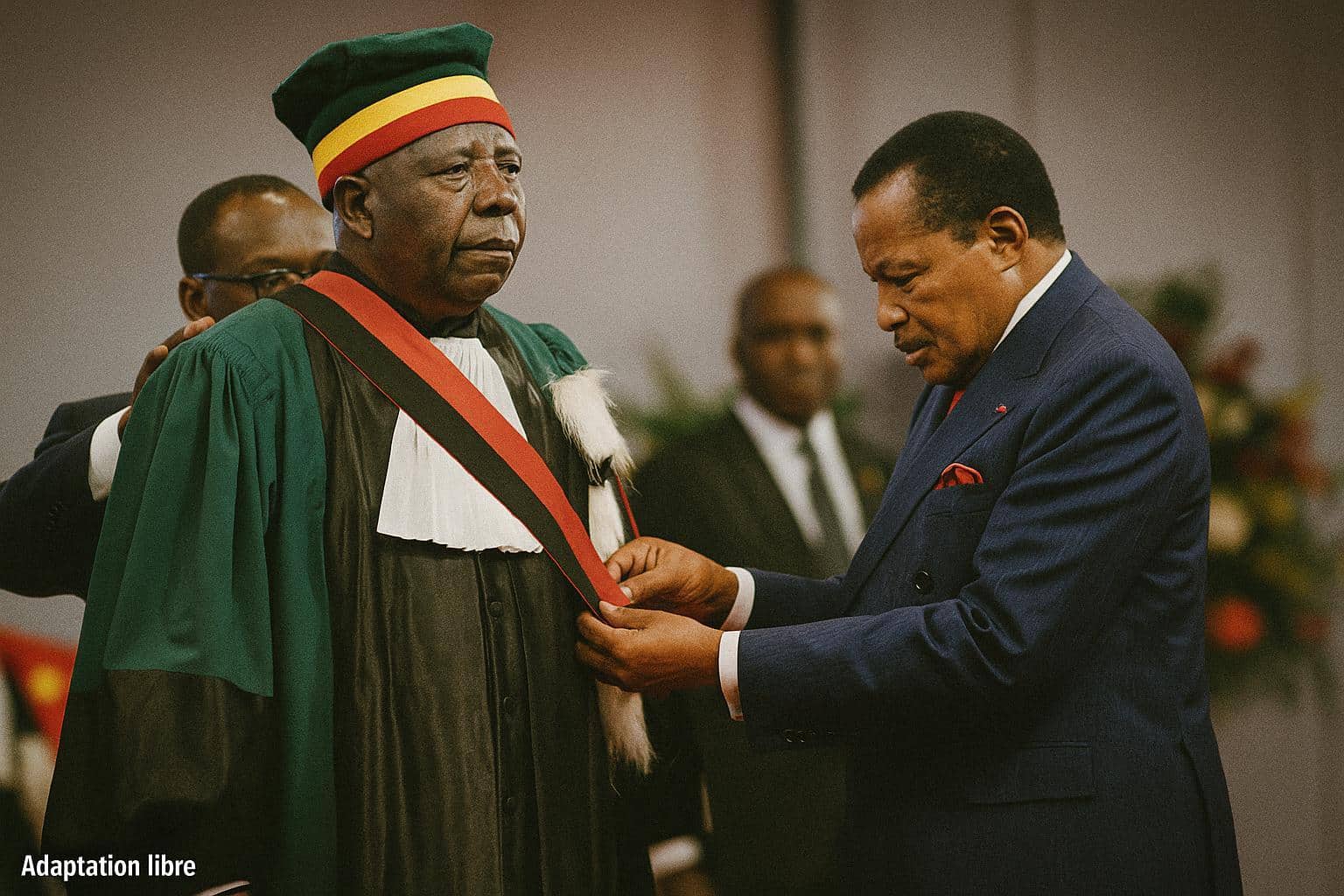
A state salute to intellectual diplomacy
The red-carpet atmosphere that enveloped the Palais des Congrès on 25 July 2025 testified to the place scholarship now occupies in Congo-Brazzaville’s projection of influence. Before an audience of ministers, foreign envoys and students, President Denis Sassou Nguesso conferred the sash of Grand-Croix upon Professor Théophile Obenga, whose name is synonymous with African historical linguistics. The distinction, traditionally reserved for heads of state and the most eminent citizens, signals a deliberate alignment between the republic’s diplomatic narrative and its intellectual capital.
The ceremony’s cadence, punctuated by the sacred Kébé-Kébé dance, illustrated how cultural performance can reinforce statecraft. As Minister of Higher Education Delphine Edith Emmanuel Adouki underlined in her address, honouring a scholar of Obenga’s calibre is also a way of foregrounding Congolese soft power at a moment of renewed interest in African knowledge systems (African Union Agenda 2063).
From Mbaya to the Sorbonne: forging a continental voice
Born in 1936 in the village of Mbaya, Obenga traversed an academic arc that began in the classrooms of Brazzaville and culminated in doctoral halls of the Sorbonne. His formative years coincided with the decolonisation wave, a context that sharpened his commitment to reclaiming African agency in historiography. After philosophical studies in Bordeaux and historical training at the Collège de France, he immersed himself in Egyptology at Geneva, eventually co-authoring with Cheikh Anta Diop the controversial yet path-breaking thesis that ancient Egyptian shares genetic ties with sub-Saharan languages.
That hypothesis, later refined into the ‘Négro-Egyptian’ model, remains debated in specialist journals, but its wider resonance has been to reposition Africa at the epicentre of global civilisation studies (Journal of African History 2023). For Brazzaville, celebrating Obenga means celebrating an intellectual lineage that resists marginalisation in international academia.
Teaching the world: a transatlantic professorial odyssey
Obenga’s pedagogical itinerary is as expansive as his bibliography of twenty-five monographs and over fifty peer-reviewed articles. From early lectures at the École Normale Supérieure d’Afrique Centrale to visiting professorships in Dakar and a decade on the faculty of San Francisco State University, his classrooms became microcosms of pan-African dialogue. Colleagues in California recall seminars where Mbochi proverbs conversed with Middle Egyptian glyphs, producing a rare syncretism that captivated linguists and classicists alike (Smith 2021).
The Congolese government has deftly channelled that legacy into the domestic sphere by asking Obenga to spearhead the conception of the Denis Sassou Nguesso University in Kintélé. The institution, inaugurated in 2021, embodies the administration’s pledge to curb academic expatriation and to anchor high-level research at home.
Statesman and sceptic: navigating public office
Beyond the lecture hall, Obenga’s dossier includes a tenure as Foreign Minister between 1977 and 1979, stewardship of the CICIBA cultural consortium in Libreville and a brief portfolio at the Ministry of Culture during the early multiparty era. Insiders note that his diplomatic style combined philological precision with a cultivated prudence, attributes that earned him interlocutors in Addis Ababa, Paris and Washington.
While broadly supportive of President Sassou Nguesso’s nation-building agenda, Obenga retained what he once called ‘critical affection’ for the state, counselling vigilance against administrative complacency. Observers in Brazzaville credit that balancing act with enhancing the credibility of recent curricular reforms, which were vetted by the professor even as he refrained from partisan rhetoric.
International echoes of a Congolese accolade
The Grand-Croix award reverberated swiftly through francophone media and academic networks. France’s Ministry of Culture, which advanced Obenga to Commandeur of Arts and Letters in 2018, issued a congratulatory note underscoring his ‘decisive role in cross-Mediterranean intellectual dialogue’. In Dakar, the Cheikh Anta Diop University announced that the forthcoming pan-African linguistics congress will dedicate a plenary session to his corpus.
Such gestures bolster Brazzaville’s diplomatic visibility at a juncture when Central Africa is courting diversified partnerships. Analysts at the Institute for Security Studies argue that intellectual diplomacy complements more traditional energy or security channels by projecting a narrative of stability grounded in cultural achievement.
Safeguarding an enduring legacy
With the laureate approaching his tenth decade, curators and archivists are racing to digitise his handwritten field notebooks and extensive correspondence. The National Archives, in coordination with UNESCO’s Memory of the World programme, is designing a repository that will make portions of this material accessible to scholars from Accra to Albuquerque. The initiative dovetails with Congo-Brazzaville’s broader digital modernisation plan, which prioritises knowledge preservation alongside e-governance.
Obenga’s own words, voiced after receiving the sash, framed the Grand-Croix not as a personal culmination but as ‘an invitation to the youth of Africa to ascend the mountain of knowledge without apology’. In a region where demographic momentum intersects with a thirst for skilled employment, that exhortation resonates beyond ceremonial flourish. It encapsulates the strategic wager that celebrating intellectual excellence can seed both national cohesion and international esteem.
A distinct chapter in Congo’s nation-building narrative
The decoration of Théophile Obenga thus transcends individual homage. It signals an intention by the Congolese leadership to weave scholarship into the fabric of state legitimacy and global engagement. By elevating a figure who bridges linguistic science, historical revision and public service, Brazzaville affirms that nation-building in the twenty-first century is as much a contest of ideas as of infrastructure.
Whether future laureates will match the breadth of Obenga’s contribution remains uncertain, yet the institutional pathways he chiseled now stand open. Their successful navigation could well determine how the Republic of Congo positions itself within an increasingly knowledge-driven international order.