
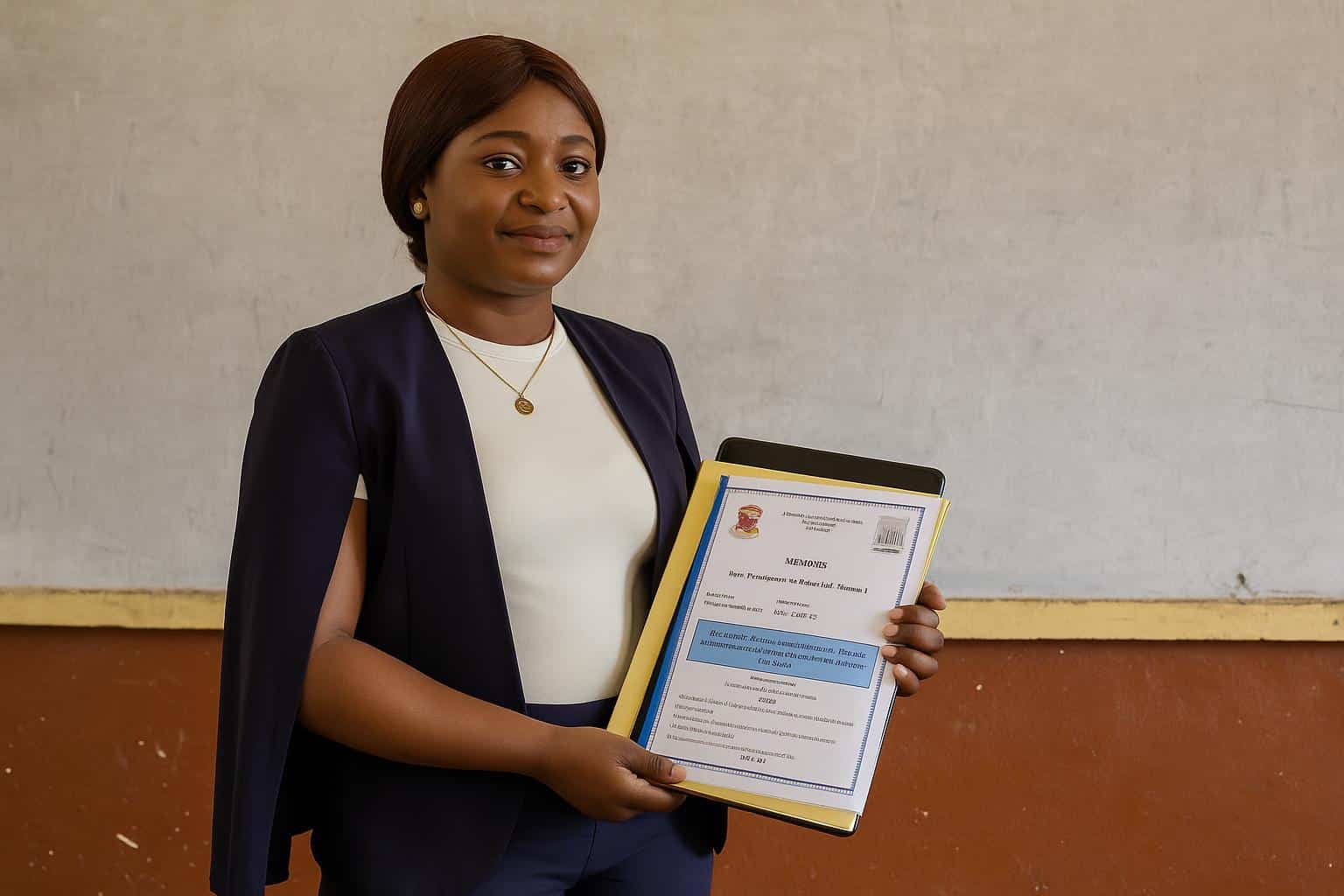
Brazzaville Master Thesis Sheds Light on School Dropout
On 12 September, a quiet lecture hall at the University Marien-Ngouabi turned into a forum on Congo’s educational future as master’s candidate Reine Mervine Gankama presented her thesis titled “The Weight of Socio-Demographic and Extra-School Factors on School Dropout in Congo”.
The jury, impressed by her statistical rigor and poised delivery, awarded the young economist a rare “Très bien” distinction with an average score of 16 out of 20, adding formal congratulations that echoed across the faculty hallways long after the defense ended.
Econometric Approach Across Nine Districts
Supervised by Professor Rufin-Willy Mantsie and lecturer M’Piayi Auguste, the research relied on a carefully constructed sample of 202 pupils drawn from all nine districts of Brazzaville, allowing the team to paint a representative portrait of urban schooling realities often hidden behind aggregate statistics.
Econometric models, some as simple as probit regressions and others more layered, tested how household profiles, neighbourhood safety and school career trajectories intersect. The approach, according to Gankama, provided “objective lenses” capable of isolating drivers that anecdotal conversations usually mix or overlook.
Socio-Demographic Factors Influencing Pupils
Findings show that a father’s educational attainment, daily food quality and the parents’ profession weigh heavily on a child’s likelihood of reaching secondary school. Where fathers finished only primary education, dropout probabilities rose markedly, suggesting intergenerational learning gaps that start at the dinner table.
Gankama notes that meals rich in protein correlate with stronger attendance records, while irregular breakfasts often precede absent afternoons. Coupled with professional instability — notably informal trade or daily wage labour — nutritional uncertainty appears to sap both student concentration and parental ability to supervise homework.
Environment and Peer Dynamics Matter
Beyond the household gate, exposure to neighbourhood insecurity and juvenile delinquency emerged as significant predictors. Pupils navigating streets where petty crime flares after dusk were statistically more prone to skip classes, especially following a repeated grade that had already dented their academic self-confidence.
Parental history mattered, too. Where one or both parents had themselves left school early, the probability of early withdrawal for their children increased, hinting at social norms that treat schooling as optional rather than essential once basic literacy and arithmetic seem secured.
Researcher’s Motivation and Vision
Asked why she chose the topic, the researcher answered without hesitation: “We care deeply about education in Congo, and empirical analysis is our way of serving that cause.” She believes rigorous data can complement existing government efforts aimed at universal access by clarifying where interventions work.
Her attachment, she adds, springs from childhood memories of classmates disappearing mid-term because fees went unpaid or because a household needed an extra pair of hands at the market. The thesis was a chance to turn those memories into measurable variables leaders can debate.
Actionable Recommendations for Policymakers
Among the clearest policy options, Gankama proposes establishing school canteens that guarantee at least one balanced meal each day for children from low-income families. Such a measure, she argues, would cushion the nutritional shocks that currently push many pupils to prioritise casual work over class.
She also calls for community campaigns reminding parents of their decisive educational role. From attending report days to providing calm study corners at home, parental engagement, the study suggests, reinforces retention more cost-effectively than expensive infrastructure, especially during the vulnerable transition from primary to junior secondary.
Targeted scholarships constitute her third recommendation. By concentrating resources on pupils whose household heads work in unstable informal sectors, she believes the state can prevent the point at which a single late fee crystallises into permanent departure from the classroom.
Academic Community Applauds Methodology
The examination panel, chaired by UMNG lecturer Samba Bruno and including Mavoungou Soula Ulrich alongside co-supervisor M’Piayi Auguste, praised the clarity of her econometric specifications. “Solid, relevant and elegantly defended,” Bruno summarised, adding that the work “deserves diffusion beyond academic shelves.”
Potential Impact on National Education Strategy
Education analysts present at the defense suggested that the thesis could feed upcoming reviews of the national Education Sector Strategy. By mapping dropout determinants so precisely, they argued, policymakers gain a diagnostic tool able to direct limited budgets toward the children most at risk.
Next Steps for Data-Driven Education
For Gankama herself, the accolade marks only the beginning. She plans to refine the model with longitudinal data and hopes to collaborate with education authorities in Pointe-Noire and interior departments, translating statistical insight into pilot programmes that keep more pupils on the school bench.
If such partnerships materialise, the master’s thesis defended on a calm September afternoon could resonate into classrooms across Congo, demonstrating how one student’s disciplined inquiry adds to a collective national effort — endorsed by government, academia and communities alike — to leave no learner behind.
Observers from neighbouring CEMAC states attending the defense expressed interest in replicating the model, arguing that shared urban challenges across the region could benefit from comparable evidence, potentially fostering cross-border collaboration on school retention strategies.