
Back-to-school spirit in Brazzaville
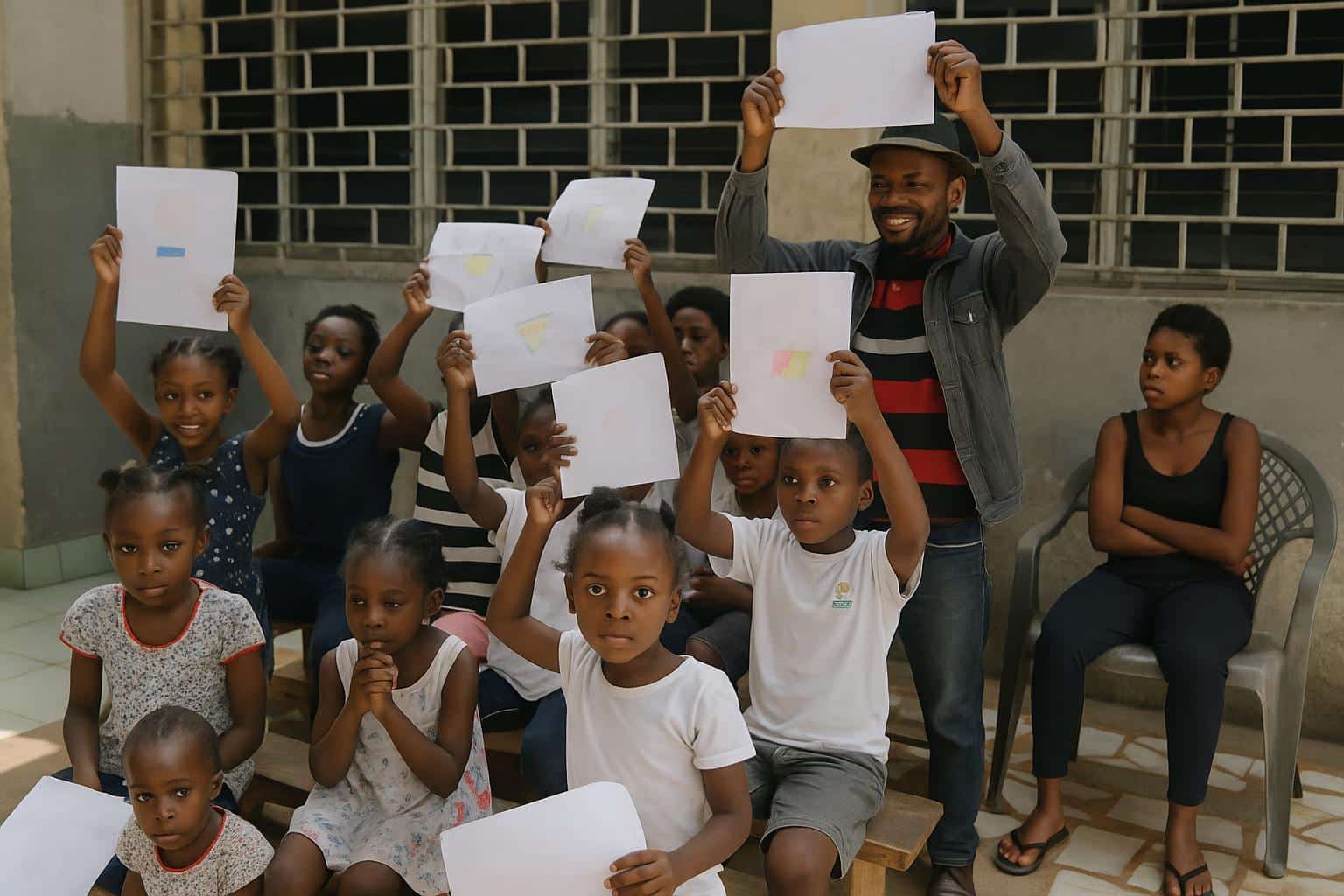
Three days before classes reopen across Congo, laughter and a faint scent of fresh notebooks floated through two Brazzaville orphanages as volunteers from the Borja Kouila NGO placed brand-new school kits into the hands of 53 children eager to rejoin their classmates.
The gesture, staged on 26–27 September under the recurring banner “Tous pour l’éducation,” delivered exercise books, pens, backpacks and reusable water bottles to residents of Les Œuvres de la Foi in Talangaï and La Croix d’Amour in Ouenze, the capital’s sixth and fifth districts.
Economic relief for vulnerable children
By targeting orphans, the initiative aims to cushion families and caregivers from a back-to-school bill that averages 25,000 CFA francs per pupil in urban areas, according to the National Institute of Statistics, and thereby keep attendance curves pointing upward.
“The start of the academic year can be stressful, especially for children without parents,” explained Barlain Atimakoa, the organisation’s communications secretary. “If we equip them properly, we give them confidence and we give the country an extra brick in its development wall.”
Each kit contained eight 100-page notebooks, four pens, two pencils, a geometry set, a 16-gigabyte USB stick for computer classes and a sturdy satchel emblazoned with the campaign’s logo, an inventory that mirrors the Ministry of Primary and Secondary Education’s standard supply list.
Voices inside Talangaï and Ouenze
While the volumes may seem modest, educators at Les Œuvres de la Foi said the timing is crucial. “An exercise book received in June can already be half-used by September,” noted Sister Angéline, head caregiver. “What arrived this week will serve immediately.”
Inside the courtyard, twelve-year-old Prisca Mabiala clutched her new backpack. “I want to become a nurse because nurses helped me when I was sick,” she said. “The bag means I can keep my books safe and maybe lend some pages to my friend.”
Leaders of La Croix d’Amour echoed the importance of kindness for learning outcomes. Director Jean-Régis Makou responded with improvised songs of thanks and promised to send grade reports to the donors at semester end as evidence of the kits’ concrete impact.
Government objectives and civic partnerships
The action aligns with government priorities. The Education for All strategy adopted in 2021 seeks to push primary enrollment beyond 95 percent by 2025, with special measures for vulnerable children (Ministry of Education, 2023). Civil-society help, authorities say, accelerates that trajectory.
In a telephone interview, departmental education inspector Joseph Loubaki welcomed the donation. “Partnerships of this nature demonstrate that quality schooling is everybody’s business,” he said, citing recent figures showing 28,000 learners enrolled in Brazzaville orphanages and foster homes last year.
Looking ahead, BK-Ong plans to integrate its databases with the state’s digital scholarship portal, launched last year to streamline aid distribution. Technical teams from the Ministry’s IT unit have scheduled a workshop in November to show smaller nonprofits how to upload beneficiary information securely and avoid duplication, officials confirmed.
If successful, the partnership could triple the reach of next year’s kit distribution campaign.
Behind the funding and delivery chain
For Borja Kouila, formed in 2018 with headquarters in Makélékélé, material aid is only one strand. The NGO also brokers apprenticeships for teens leaving care and organizes weekend tutoring in mathematics and reading. Some 320 youngsters have benefited to date, the group says.
Funding comes from member dues, small business partners and occasional crowdfunding drives among the Congolese diaspora in France and Canada. The latest campaign on a popular platform raised 2.4 million CFA francs in six weeks, enough to cover the current kits and logistics.
One logistics wrinkle was simply reaching Talangaï, where the avenue leading to Les Œuvres de la Foi is still under repair after seasonal rains. Volunteers loaded supplies onto three-wheelers for the final kilometre, drawing curious glances from neighbours and passers-by.
Education gains beyond the courtyard
Internationally, such micro-interventions complement broader programmes. UNICEF lists school supplies among the fastest ways to stabilise attendance after shocks like pandemic closures (UNICEF, 2022). Research in Cameroon found that providing a basic kit reduced drop-out risk by 12 percent in comparable urban settings.
Congolese sociologist Élodie Bantsimba frames the practice as social cement. “Giving a pen today can avert social fractures tomorrow,” she argued in a telephone interview. She urged more coordination among NGOs to avoid overlap and channel scarce resources toward the least-served districts.
Barlain Atimakoa said discussions are already under way with two rural schools in Plateaux Department, where distance and poverty compound obstacles. “Our dream is that no pupil be forced to trade a pencil for a day’s meal,” he said.
Until then, Prisca and her peers are counting the days to 1 October, opening and closing their satchels like secret chests. Their anticipation, shimmering in the late-afternoon sun, may be the most persuasive argument yet for keeping the “Tous pour l’éducation” caravan rolling.