
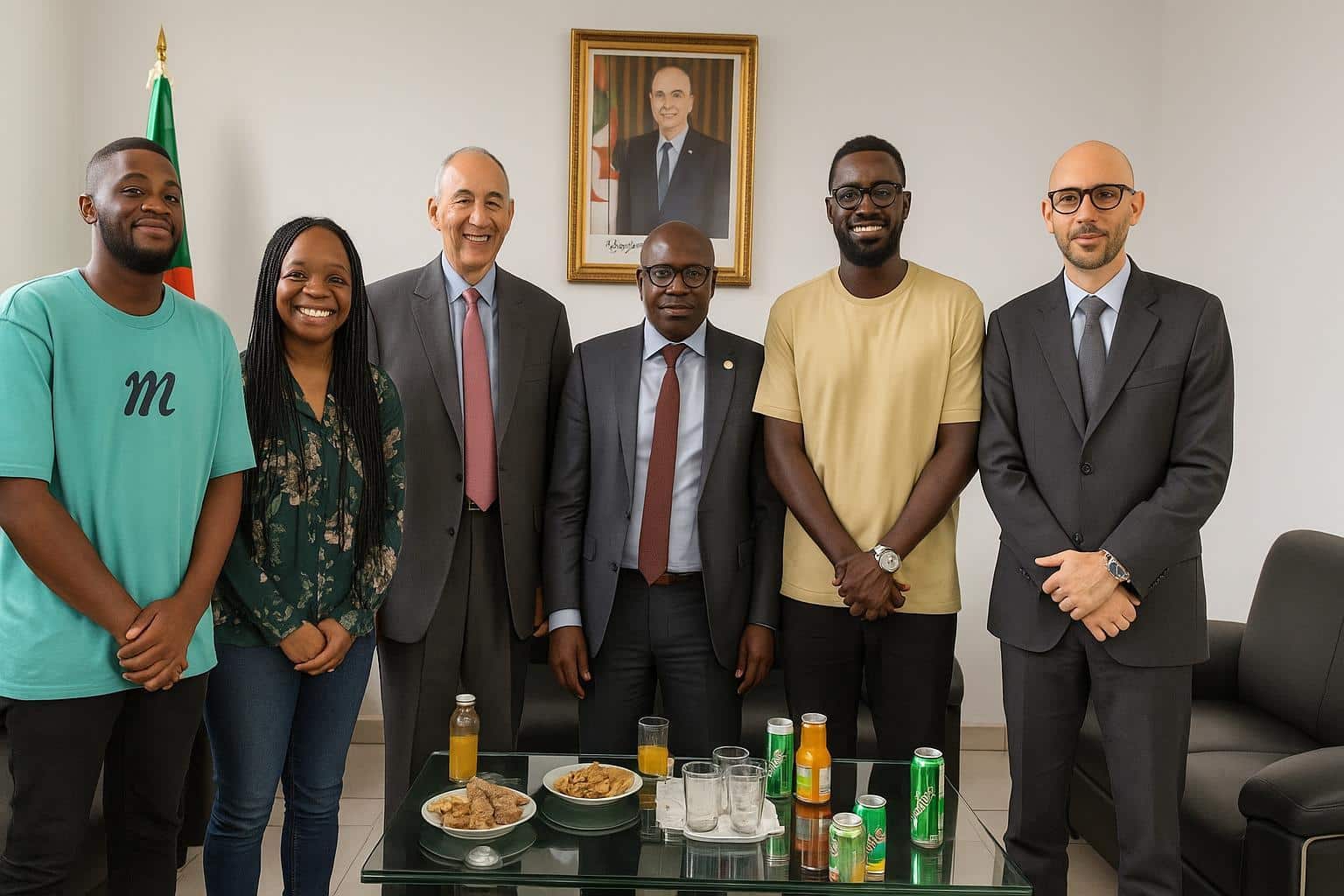
Brazzaville send-off underscores academic ties
Brazzaville’s diplomatic quarter was lively this week as Ambassador Azeddine Riache bid farewell to ten Congolese graduates awarded master’s scholarships at Algeria’s National Higher School of Social Security, renewing a long-standing academic bridge between the two Central African partners.
Gathered beside freshly hoisted flags, the students listened while the envoy praised what he called “a commitment to shared progress,” citing the 2022 bilateral roadmap on education signed by Ministers Abdelbaki Benziane and Delphine Edith Emmanuel as the framework guiding this new cohort.
Officials from Congo’s Ministry of Higher Education highlighted that these grants are the first master-level places offered since cooperation resumed post-pandemic, complementing existing undergraduate quotas in medicine and petroleum engineering. “We are diversifying disciplines in line with Plan National de Développement 2022-2026,” Secretary Lucie Okandza noted.
Selecting future social protection leaders
The Ecole nationale supérieure de la sécurité sociale, created in 1969 to train Algerian pension officers, now welcomes African candidates through a competitive dossier review. This year, Congo presented thirty-four applications; ten were retained after academic ranking, language tests and interviews led by a joint pedagogic commission.
According to the school’s prospectus, the two-year curriculum blends actuarial science, health economics and public-policy analytics, concluding with a professional thesis defended before representatives from Algeria’s CNAS and the International Social Security Association. Graduates earn a double seal valid in Francophone Africa and the Arab Maghreb.
Congo’s National Social Security Fund has already signalled that successful candidates will be fast-tracked into analyst positions upon return. “We need fresh talent able to digitalize contribution records and design actuarial tables for the informal sector,” Deputy Director Alain Itoua told our newsroom, welcoming the Algerian partnership.
For the students, selection was both merit-based and need-sensitive. Several are first-generation university alumni from departments such as Niari and Cuvette. Scholarship benefits include tuition, accommodation in Algiers’ Ben Aknoun campus, health coverage and a monthly stipend equivalent to 120 euros, fully financed by the Algerian budget.
Life and learning in Algiers
Algiers’ Mediterranean climate and French-Arabic bilingual environment present both comfort and challenge. “We will attend intensive Arabic classes during the first semester to ease fieldwork inside local agencies,” said scholarship recipient Prisca Mavinga, a statistics graduate from Marien-Ngouabi University.
Director Abdelkader Bouchareb stressed by telephone that students access World Bank-grade actuarial software and fieldwork labs with Algerian micro-entrepreneurs, giving them hands-on insight into self-employed welfare regimes, a topic Congo plans to regulate next year.
Diplomatic dividend of education exchange
Education advisers in both capitals see scholarships as quiet diplomacy. Algeria has funded over 600 Congolese learners since 1972, while Brazzaville offers French-language slots to Algerian civil servants. Analysts say the model strengthens South-South cooperation without imposing policy strings.
Political scientist Hervé Mahinga points out that social security administration holds strategic weight amid demographic shifts. “By partnering with Algeria, Congo signals that modernisation of welfare is as vital as oil,” he said, referencing the recent promulgation of the Universal Health Insurance Law in Brazzaville.
For Algeria, the presence of foreign learners enhances institutional rankings and fuels a labour market increasingly oriented toward Africa. The Higher Education Ministry reports that Pan-African students now represent 15 percent of its postgraduate intake, up from 9 percent five years ago, aligning with President Abdelmadjid Tebboune’s continental outreach.
Homeward goals and welfare reforms
Back in Congo, the departing scholars have signed engagement letters committing to return for at least five years. The measure, framed by Decree 2021-189 on mobility management, aims to curb brain drain that once saw 40 percent of foreign-trained professionals settle abroad, according to UNESCO’s 2020 estimate.
Minister Emmanuel emphasised during the send-off that upcoming reforms of Congo’s Caisse Nationale d’Assurance Maladie Universelle will require actuaries versed in contributory systems. “These young people will help us calibrate premiums and subsidies so that coverage remains sustainable,” she said, lauding President Denis Sassou Nguesso’s vision of inclusive growth.
Families of the scholars expressed both pride and practical concerns. “We trust the state’s monitoring mechanism will ensure timely allowance transfers,” noted Marcel Boukadia, father of a recipient. Ministry officials responded that stipends will be disbursed directly through Algeria’s Bank of Foreign Trade under a bilateral guarantee.
As the group boarded Air Algérie flight AH411 in Maya-Maya Airport, applause erupted among relatives and diplomats. Their journey may cover only 2,500 kilometres, yet the educational cargo they are expected to bring back could span generations, carrying lessons that stitch economic protection ever closer to national cohesion.