
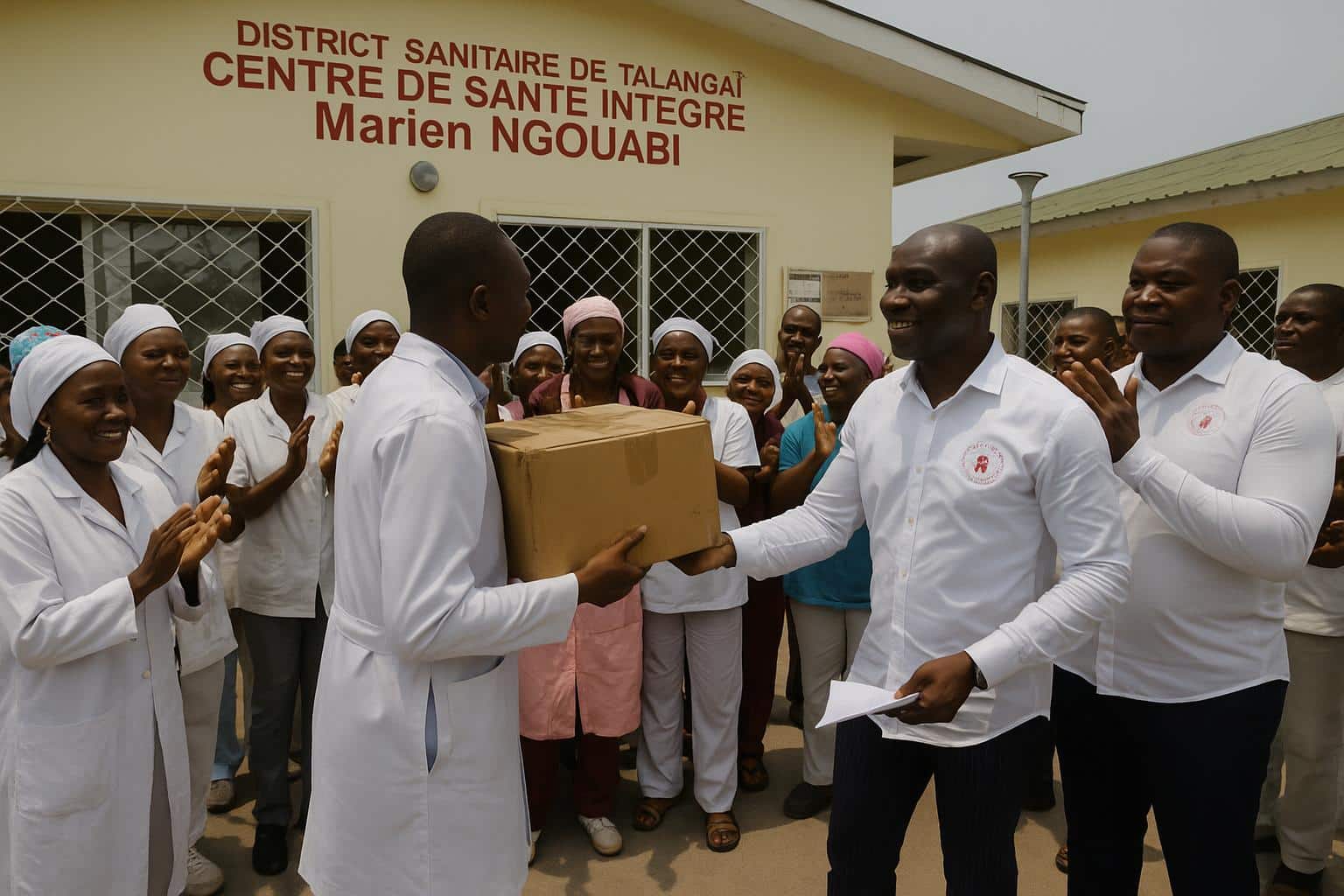
Pharmaceutical donation invigorates Brazzaville clinics
On 19 September, boxes of antibiotics, antimalarials and maternal-child health kits were unloaded at the Integrated Health Centre Marien-Ngouabi in Talangaï and its counterpart in Moukondo, Moungali. The consignment, presented by Dorel Eyobelé, carried the blue-and-white seal of the Julia-Bouya Foundation.
The package marked the first public action by the organisation in Brazzaville this semester and sought to reinforce basic stocks at two overstretched primary facilities that receive, according to staff records, more than 300 outpatient visits per day, mostly mothers and children seeking affordable care.
Honouring Julia Bouya’s legacy
Julia Bouya, a former teacher and community organiser who died in 2019, left behind a reputation for discreet generosity. Her relatives created the foundation in 2022 to institutionalise that spirit and to, in Eyobelé’s words, “transform compassion into structured programmes that endure beyond mourning”.
The organisation’s charter lists six priorities, ranging from preventive health education to financing medical research. Yet its first battlefield, board members say, remains access to essential drugs in peri-urban districts where poverty and informal housing complicate universal health-coverage goals.
To finance Wednesday’s donation, the foundation mobilised contributions from Congolese entrepreneurs in Casablanca and Paris, complemented by discounted purchases negotiated with a Pointe-Noire distributor. No public funds were involved, a point emphasised by Eyobelé to illustrate the potential of diaspora-led philanthropy.
Supporting government health ambitions
By reinforcing drug shelves, the initiative dovetails with the Health Ministry’s Primary Health Development Plan, which targets maternal mortality and preventable childhood ailments. A Talangaï district officer noted that the donation “arrives as we run low on fever syrups and prenatal vitamins after a busy malaria season”.
Officials refrained from attaching a monetary value to the crates, but pharmacists at Marien-Ngouabi estimated that the antibiotics alone would cover routine prescriptions for almost two months, relieving families who often travel downtown or turn to informal markets when stock-outs occur.
The move also eases pressure on the Central Procurement Agency, whose tenders were delayed this quarter by supplier certification checks. Health economist Pamela Ngatsé argues that “well-timed private donations can plug gaps without distorting prices, provided traceability and expiry dates are transparent to hospital managers”.
Philanthropy footprint beyond Brazzaville
Since its inception, the Julia-Bouya Foundation has diversified actions across departments. In the Cuvette, it funded treadle pumps and training for women-led cassava cooperatives; in Loudima, it distributed talking calculators to visually impaired pupils. Each effort, board reports show, links charity to longer-range empowerment.
A pilot scholarship programme is under review with the Higher Education Ministry. If approved, it would sponsor five medical students in cardiology and oncology, areas flagged by a recent WHO report as understaffed nationwide. Eyobelé says partners in Abidjan and Kigali stand ready to host sandwich internships.
Though still modest in scale, analysts view such civil-society interventions as complementary to multilateral projects like the World Bank’s LISUNGI social safety net, noting that local foundations can react faster while anchoring decision-making in cultural familiarity.
Community voices underline immediate impact
At Marien-Ngouabi, nurse Philomène Bile welcomed the prenatal kits, recalling that, two weeks earlier, three expectant mothers shared a single blood-pressure cuff. “Today we can serve them with dignity,” she said, arranging sterile gauze beside the new sphygmomanometer.
In Moukondo, community leader Omer Okoko predicted a fall in self-medication. “People sometimes split tablets because full courses are too dear. When clinics are stocked, adherence improves,” he noted, adding that volunteers will track prescription compliance through house-to-house visits over the coming month.
The local imam, Abderamane Yonda, offered the mosque’s courtyard for weekly health-education talks led by midwives. He stressed that “faith and science must meet where families gather”, echoing the foundation’s strategy of coupling material aid with behavioural-change outreach.
Eyobelé hinted that a follow-up delivery is slated for December, subject to customs clearance of pediatric formulations arriving from Casablanca. In the meantime, clinic managers will share consumption data fortnightly; their reports will guide the next procurement batch and shape the foundation’s 2024 budget proposal.
For patients queuing under corrugated awnings, the cartons of medicines symbolise more than pills; they signal a growing alliance between civic goodwill and public policy, one that, if cultivated, could quietly strengthen the national health fabric clinic by clinic, street by street.
Data-driven oversight ensures transparency
Transparency, foundation officials contend, is critical to sustaining donor confidence. Every batch number from the September shipment was logged in a digital platform designed by Congolese startup AskaTech. The application geotags storage rooms, flags approaching expiry dates and uploads inventories to a public dashboard updated weekly.
According to AskaTech engineer Mireille Nsona, the system draws on open-source code and costs under 300,000 CFA francs per clinic annually, far below comparable off-the-shelf solutions. “Low-tech does not mean low-standard,” she said, noting that district inspectors can audit data in real time.